Bubble Shooter tips: use the walls and make each pop count
The easiest match is not always the most useful one. Before firing, look above the bubbles you want to pop: removing a small connection can release a whole section. The trick is reaching that connection without closing your own route.
Play Bubble Shooter →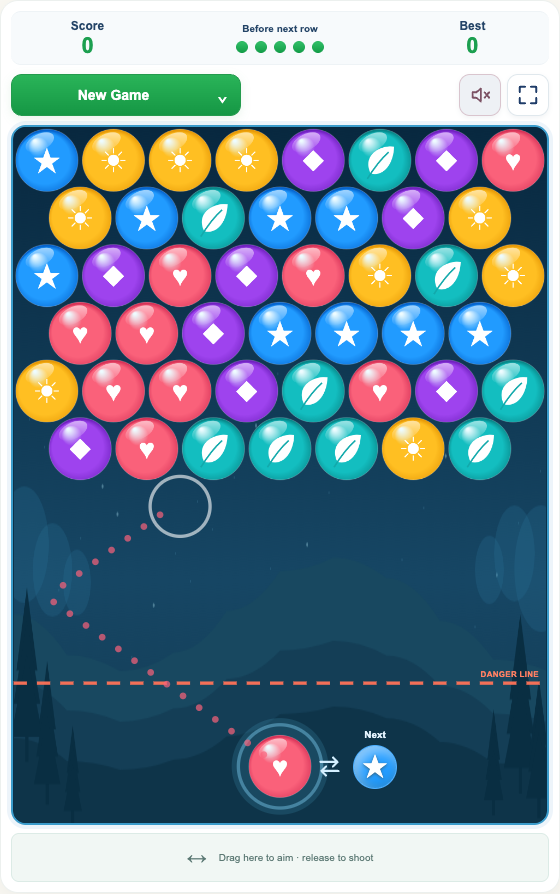
Check the current bubble, the next bubble and the landing space
Your shot must join a connected group of at least three bubbles of the same color, counting the bubble you fire. They do not need to form a straight line. Check the current bubble at the launcher and the next bubble before committing to a target. The symbols help distinguish colors.
On desktop, move the pointer over the board to aim and click to fire. On a phone, tapping the board shoots; for a more deliberate shot, drag the aim pad and release when the preview looks right. Keyboard controls are Left and Right to aim, Shift for smaller adjustments, Enter or Space to fire and X to swap.
There is no countdown or fixed supply of shots. The pressure comes from new rows and the danger line. You have time to inspect the board before every shot.
Use a wall when the direct route is blocked
A wall bounce changes the horizontal direction of the shot while it keeps traveling upward. It can reach a side of a group that a direct shot cannot reach. Follow the dotted preview all the way to its landing circle; aiming roughly at the right color is not enough.
In the teaching board below, the shot follows the left wall and joins a larger same-color group. This is a particular position, not an angle to memorize for every game. The narrow and wide layouts have different geometry, so read the preview on your own board.
The aim line is built in. There is no pointer item to collect or buy, and bouncing itself earns no extra points. Use a bank shot because it reaches a useful match, not simply because it looks clever.
Remove the support, not just the lowest bubbles
After a matching group pops, the game checks which bubbles still connect to the top row. A section with no connection drops, even if its bubbles are different colors. If it still has another route to the top, it stays. Inspect those connections before expecting a large fall.
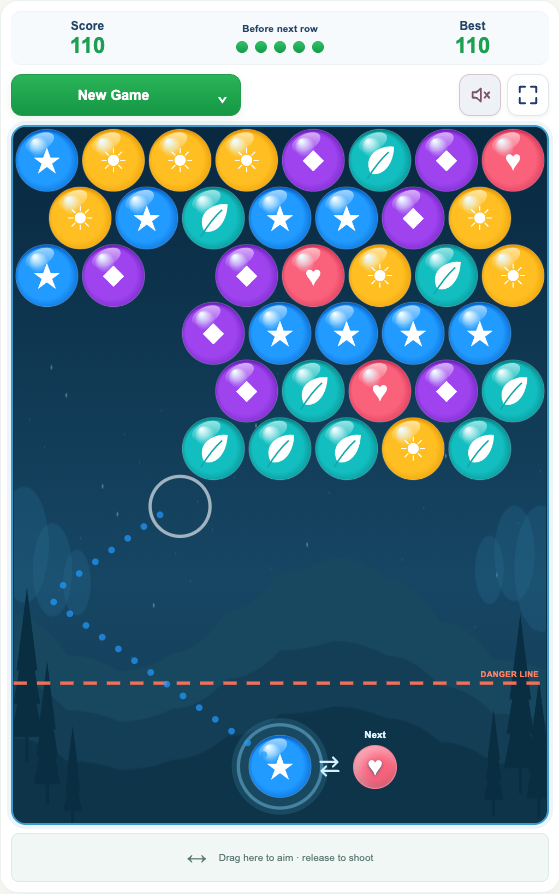
The illustrated shot pops seven bubbles, including the one fired, and drops two unsupported bubbles. Popped bubbles earn 10 points each; dropped bubbles earn 20. That gives 7 × 10 + 2 × 20 = 110 points. The board is not empty, so this shot does not earn the separate 500-point clear bonus.
Compare the two pictures: the useful result is not only a higher score but also more room to aim. A reliable small clear can still be the better choice when a large drop requires a route you cannot reach.
Swap before building an awkward stack
If the current color has no useful match, check the next bubble. Swap exchanges the two; it does not shoot, add a row or spend one of the meter’s remaining steps. In the screenshot, the swap happens after the 110-point shot, so the score remains 110.
Swapping again simply gives you the same two bubbles back. It is not a way to request a third color. Compare what each of the two can accomplish, then choose the one with a useful landing place.
Sometimes a shot that does not pop anything can prepare a later match. Use that only when you can see a follow-up and afford a meter step. Keep a route open to the group you are building rather than attaching bubbles wherever there happens to be space.
Read the gaps instead of trusting a fixed left-or-right rule
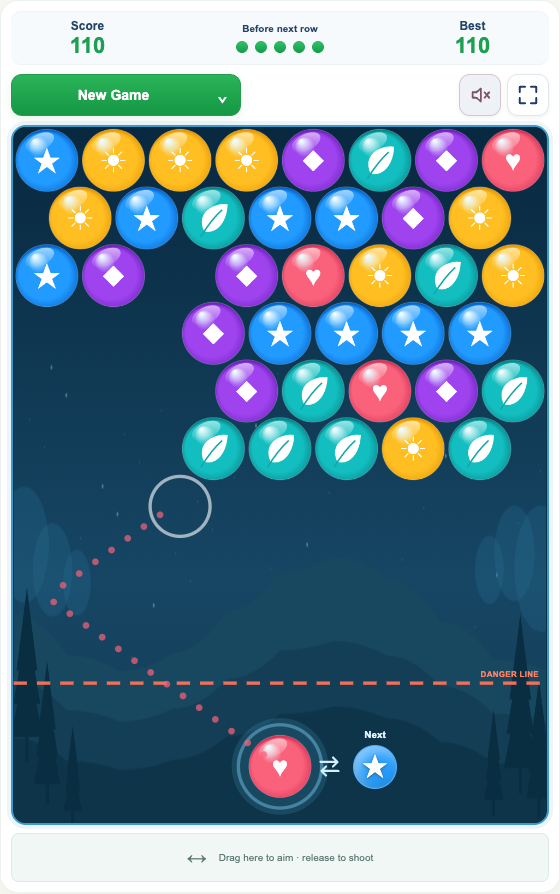
Bubbles sit in staggered rows, so the available attachment positions change from row to row. There is no reliable rule that every full row pulls a shot right or every shorter row pulls it left. Check the actual landing circle in the aim preview.
A gap that looks open between two circles may still be too narrow for another bubble. The shot has a width; it does not pass through bubbles or bend after contact. If the preview stops at a lower obstacle, the higher target is not reachable along that path. Try a wall route, clear the obstruction or use another match.
Do not make tiny adjustments forever just because a distant hole looks promising. If a nearby match opens more space with less risk, take it and look again at the new board.
Watch the row meter, then plan one shot ahead
The five-step meter counts shots that do not pop a group. Each such shot uses one step. A successful pop leaves the remaining count where it is; it does not reset it to five. For example, a miss, a pop and another miss leave three steps. On the fifth non-popping shot, a row is added at the top and the meter returns to five.
A new row pushes the existing bubbles downward. The round ends if any bubble reaches the danger line, so a setup shot becomes more costly when only one meter step remains or the board is already low. There are no bombs or rescue items to wait for in this version.
For the next round, practice one routine: compare both available colors, trace the landing path and check the remaining meter steps. Restart Board lets you try a different route on the same starting board; it resets that attempt’s score. Your game and best score save in this browser when storage is available.