Sudoku tips: give every number a reason
Nine digits. Eighty-one cells. Somehow, the one you need is always hiding. If you can fill a nearly finished row but get stuck halfway through a puzzle, this guide is for you. Start with what you can prove, let the notes do some work, and save the dramatic theories for later.
Play Sudoku →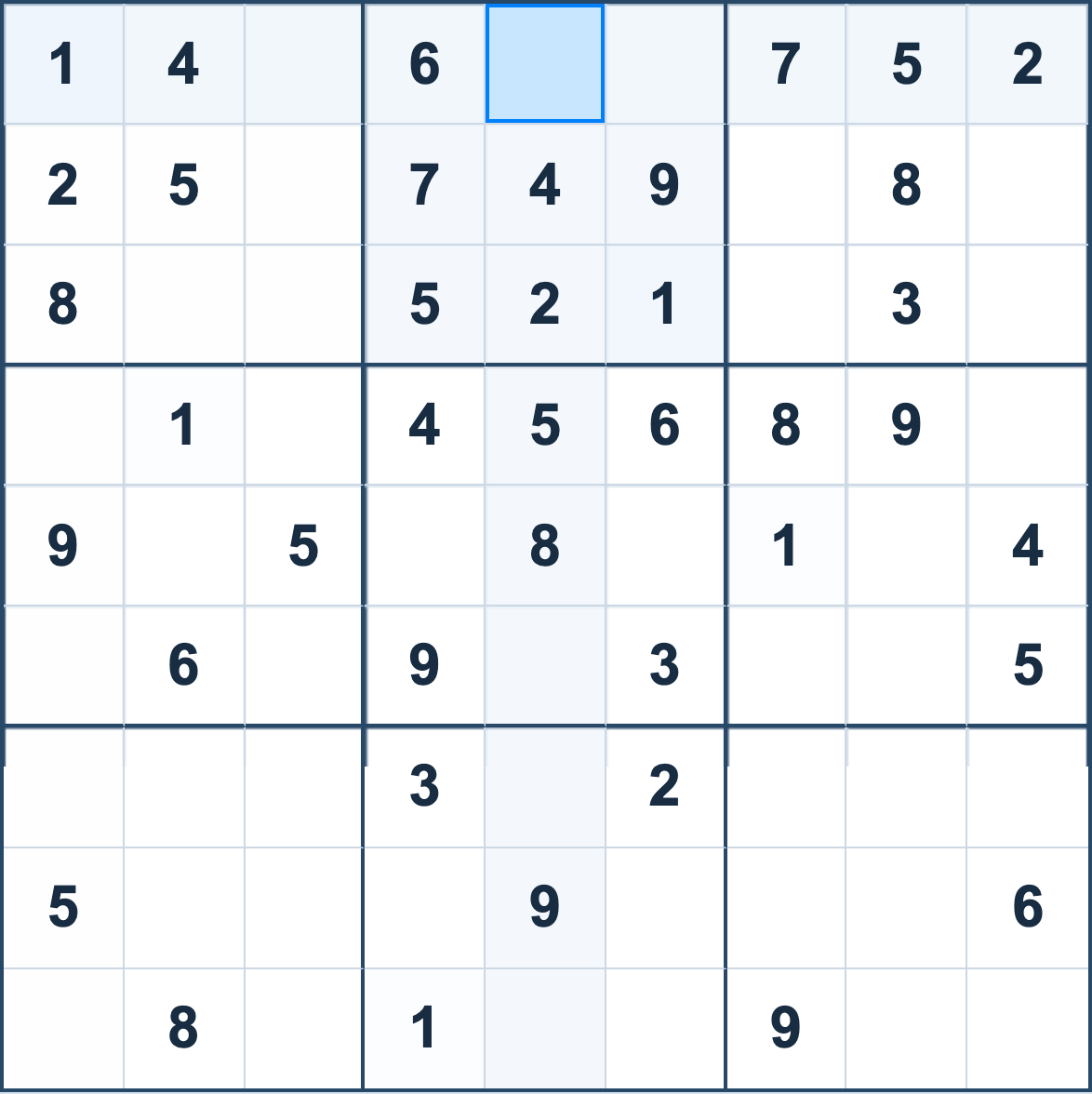
Get your bearings before touching the number pad
Every row, column and 3 × 3 box must contain 1–9 exactly once. Given digits stay fixed. We write r5c2 for row 5, column 2, counting from the top left. A candidate is a digit not yet ruled out by the filled cells in those three units. It is a possibility, not a promise.
On OnlinePuzzle, select a cell and use the number pad or keys 1–9. Turn Notes on to write pencil marks, and off to enter an answer. N toggles Notes; arrow keys move between cells. Erase removes an entry, and Undo lets you reverse a move. Automatic note cleanup also removes that digit from related notes when you enter an answer.
Easy, Medium and Hard give you different starting puzzles. Start where you can explain most of your moves. There is no prize for staring at Hard while pretending to think.
Singles: one missing digit, or one place to put it
If a row contains 1, 2, 4, 5, 6, 7, 8 and 9, its last empty cell is 3. Check columns and boxes the same way. This last-missing-digit move is the easiest place to warm up.
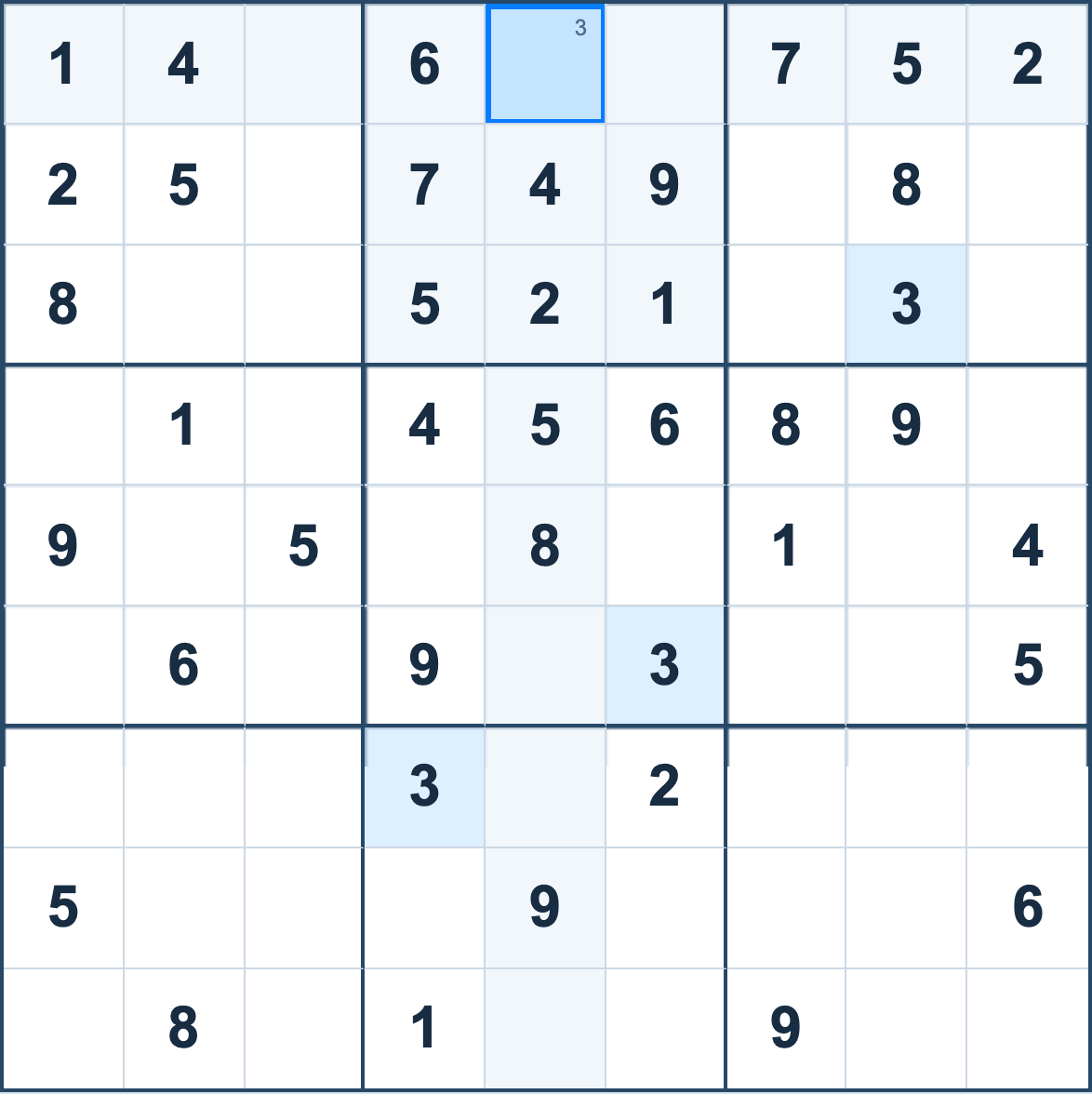
A naked single goes further: combine the exclusions from a cell’s row, column and box. If only one candidate remains, fill it. You do not need eight filled cells in any single unit. In the screenshot below, the selected cell has exactly one legal candidate after all three units are checked.
A hidden single asks the reverse question: where can a particular digit go in this row, column or box? If only one empty cell can take it, that cell gets the digit—even if its notes contain other possibilities. Scanning for a 9 across neighboring rows and columns is a way to find this, not a separate mysterious law.
Locked candidates: useful information without a final answer
Suppose every possible 2 in one box lies in column 9. You still do not know which of those cells is 2, but you know the box’s 2 occupies column 9. Remove 2 from cells in column 9 outside that box. This is a pointing deduction.
It also works the other way around. If all possible 2s in a row lie inside one box, remove 2 from the other cells in that box outside the row. This is often called claiming. In either direction, check every possible location before declaring the candidate locked.
Notice what you have proved: an elimination, not necessarily a filled cell. Do not leap from “this 2 lives somewhere in this column” to four new answers unless each next move has its own reason.
Pairs and triples: reserve seats before assigning names
A naked pair is two cells in the same unit with exactly the same two candidates, such as {2, 3} and {2, 3}. Those cells use up 2 and 3 in some order. Remove both digits from the other cells in that unit. Two cells that merely include 2 and 3 among several notes are not enough.
A hidden pair reverses the test: in one unit, digits 2 and 3 can occur only in the same two cells. Keep 2 and 3 in those cells and remove their other candidates. You still cannot choose which cell is 2 just because that arrangement looks tidier.
A naked triple uses three cells whose combined candidates are exactly three digits. For example, {1, 3}, {3, 9} and {1, 9} reserve 1, 3 and 9. Remove those digits elsewhere in the shared unit. Each cell need not contain all three notes; the union and the shared unit are what matter.
X-Wing: a rectangle with very specific rules
For one digit, suppose row 4 has exactly two candidate positions, columns 3 and 9. Row 9 has exactly the same two positions. Each row needs one copy, and each column permits only one. The digit therefore occupies opposite corners of this rectangle.
You may remove that digit from columns 3 and 9 outside rows 4 and 9. For example, a 6 at r1c9 can be eliminated if the rectangle is for 6. But r1c9 becomes 8 only if 8 is its sole remaining candidate. The rectangle alone does not supply the replacement digit.
Four cells that happen to contain the same note are not automatically an X-Wing. Each of the two source rows must have exactly those two locations for the digit. Swap rows and columns for the column-based version.
Branches: a deduction needs an ending
If a cell has exactly two candidates, A and B, you can explore each assumption separately. If both valid chains force the same result elsewhere, that common result is established. Record the branches carefully; mixing their temporary entries produces very convincing nonsense.
If assuming A leads to a genuine contradiction—for example, a cell with no candidates or a missing digit with no position in a unit—A can be eliminated. That is proof by contradiction. Two incompatible forced values in one cell also signal a contradiction, provided every step was valid.
Failing to find a contradiction does not prove a guess correct. You may simply not have followed it far enough. Keep assumptions separate from confirmed answers. For practice on the site, use Undo to retrace trial entries carefully, or work the branches on paper. Never promote an unfinished branch to a solved fact.
Use hints as a teacher, not a mysterious answer button
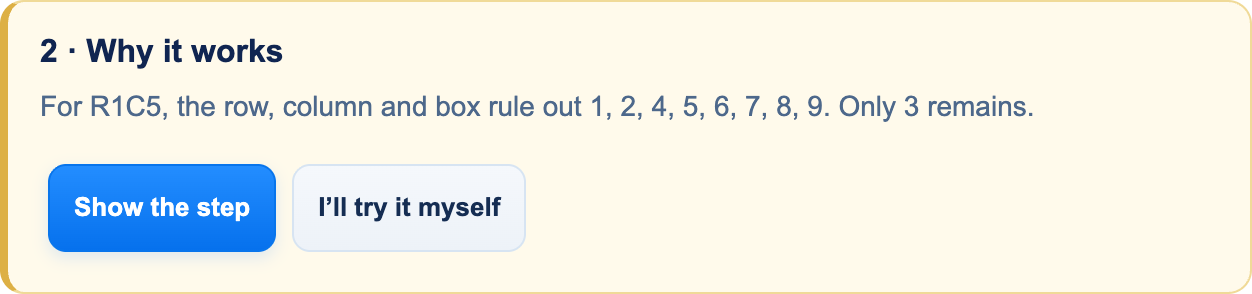
The Hint tool first shows where to look. Show why explains the deduction; Show the step makes the action explicit. Apply this step is the separate action that changes the board. Try stopping at the explanation and making the move yourself.
Conflict highlighting detects repeated digits in a row, column or box. A quiet board does not prove every answer is correct. Check puzzle compares your filled answers with the solution after confirmation; it does not grade pencil notes or fill answers automatically. Mistakes do not end the game.
Notes only record what you have entered. A cell showing one pencil mark is not automatically a naked single: perhaps you forgot the other candidates. Recheck the row, column and box before trusting it.
A repeatable routine beats an eight-step miracle
Scan nearly complete units, look for singles, then update candidates. Next check locked candidates and pairs or triples. Every successful placement or elimination is a reason to return to singles: advanced work often creates a very ordinary next move.
If that stalls, check the other parts of the board before trying an X-Wing or a carefully recorded branch. The best technique is the simplest one the current position actually supports.
There is no universal eight-step shortcut for generated puzzles. Without the exact grid and a proof for each move, a sequence cannot be reused safely. Practice recognizing the conditions, not copying coordinates. Then play another round. This time, make every number earn its place.