Merge Fruit tips: leave room for the next pair
Two big fruits almost touching, with one tiny blueberry wedged between them: that is often where a good run starts to go wrong. The aim is not to fill every gap. It is to leave the next matching fruit a route in.
Play Merge Fruit →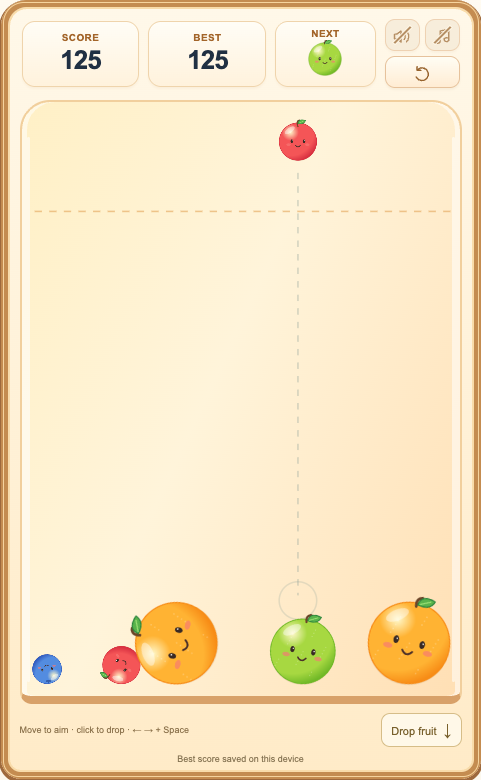
Look at the current fruit and the next one
Move horizontally to aim, then click to drop. On a phone, drag inside the bowl and release, or tap a position. The guide marks your drop column; it does not predict where the fruit will finish after rolling.
Before releasing, check the Next preview. If the next fruit already has an accessible partner, avoid covering that partner with the current fruit. Sometimes a quiet placement at the side is more useful than an immediate merge in the middle.
Only blueberries, cherries, strawberries, limes and oranges arrive from above. Apples and every larger fruit must be made by merging. You cannot wait for a coconut to appear in the preview.
Build a side, but keep the surface low
Try growing your larger fruits toward one side, leaving the other side available for smaller pairs. This is a useful starting plan, not a layout you can force: round fruit rolls, and a merge can shift the pile.
Look for a broad, low landing area. A tall stack against a wall can reach the danger line while much of the bowl is still empty. If one side is getting high, use an accessible pair lower down instead of adding another layer.
Do not aim for a mathematically perfect arrangement. The fruits have different sizes and keep changing when they merge. A gap is useful if it leads to a matching fruit; it is less useful if anything dropped there will be buried.
Deal with small blockers while you can reach them
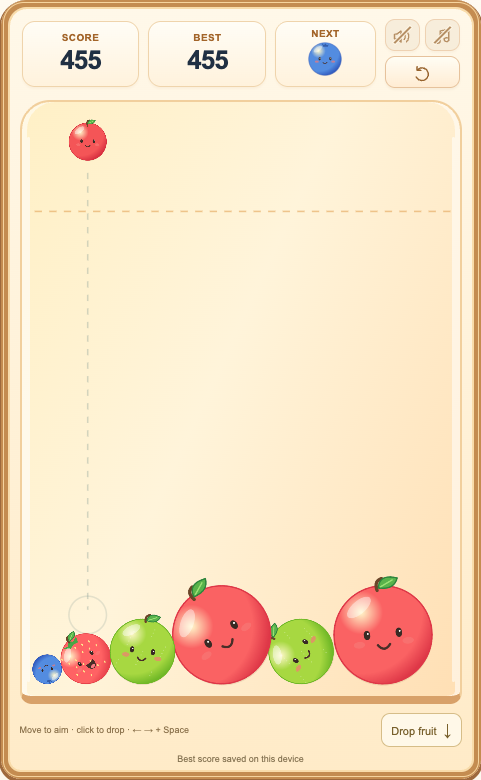
A small fruit between two larger matching fruits can keep them apart. The problem is access: once the gap is covered, you may have no way to bring in its partner.
If the small fruit is still exposed, try dropping its match along the open side. Check what that merge will create, too. Two blueberries become a cherry, so the blocker gets bigger rather than vanishing. A nearby cherry could continue the chain; without one, you may still have a blocker.
Avoid dropping a small fruit into a deep slot merely because it fits. Leave yourself a way to develop it. When a fruit is already buried, work on reachable pairs around it rather than repeatedly dropping onto the same closed gap.
Wait for rolling, and plan one merge ahead
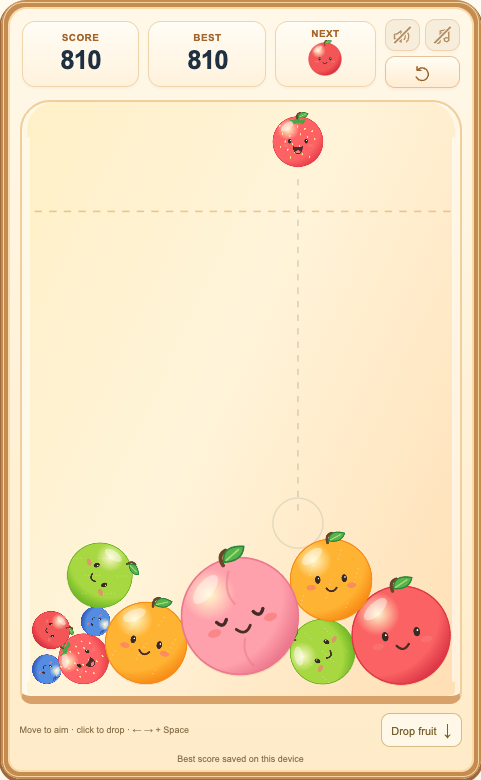
There is no round timer. After a drop, let the fruit roll and watch any merges finish before choosing the next landing. Rapid drops can cover a pair that was about to meet.
A simple chain is two cherries becoming a strawberry beside another strawberry. If the new fruit touches that strawberry, they become a lime. Keeping neighboring stages accessible gives this kind of chain a chance.
You control the horizontal release point, not a launch angle. A fruit can roll off another fruit or react to a wall, but this is not a Bubble Shooter bank shot. Aim for an open approach and allow for movement; there is no reliable wall-bounce formula that guarantees a hit.
Know what actually earns points
Dropping a fruit earns no points. Each merge adds the value of its result: cherry 10, strawberry 20, lime 35, orange 55, apple 80, peach 110, coconut 150, pineapple 200, melon 260 and watermelon 350.
For example, two cherries make a strawberry for 20 points. If that strawberry immediately merges with another strawberry, the lime adds 35 more: 55 points in total. Combo messages celebrate the chain; they do not multiply these values.
Making a watermelon does not end the run. Two watermelons merge away for 500 points, freeing space to keep playing. There is no separate 100-point watermelon bonus or extra score for overflowing the bowl. Choose merges that preserve access, rather than risking the whole run for one larger result.
Treat the danger line as a warning, not spare space
The orange line is not an instant-loss barrier for a falling fruit. After contact, a fruit that remains above the line at low speed for 1.8 seconds ends the run. If it drops below the line or merges, its warning resets.
Near the top, look for an accessible merge that could lower the pile. Adding unrelated fruit above the blockage usually makes the situation worse. Even a merge can shift fruit upward, so watch the result before dropping again.
No placement strategy guarantees a win or a particular ranking. Review the move that blocked a useful pair or built a tall stack, and try a different placement next time. Your best score is saved in this browser when storage is available, but the current bowl is not restored after a reload.