Slope Game Guide: Controls, Obstacles & High Score Tips
The key to a better Slope score is to steer early and release early. Read the next opening, make one controlled adjustment, and let the ball settle before the next obstacle. This guide explains how to put that rhythm into practice.
Play Slope Game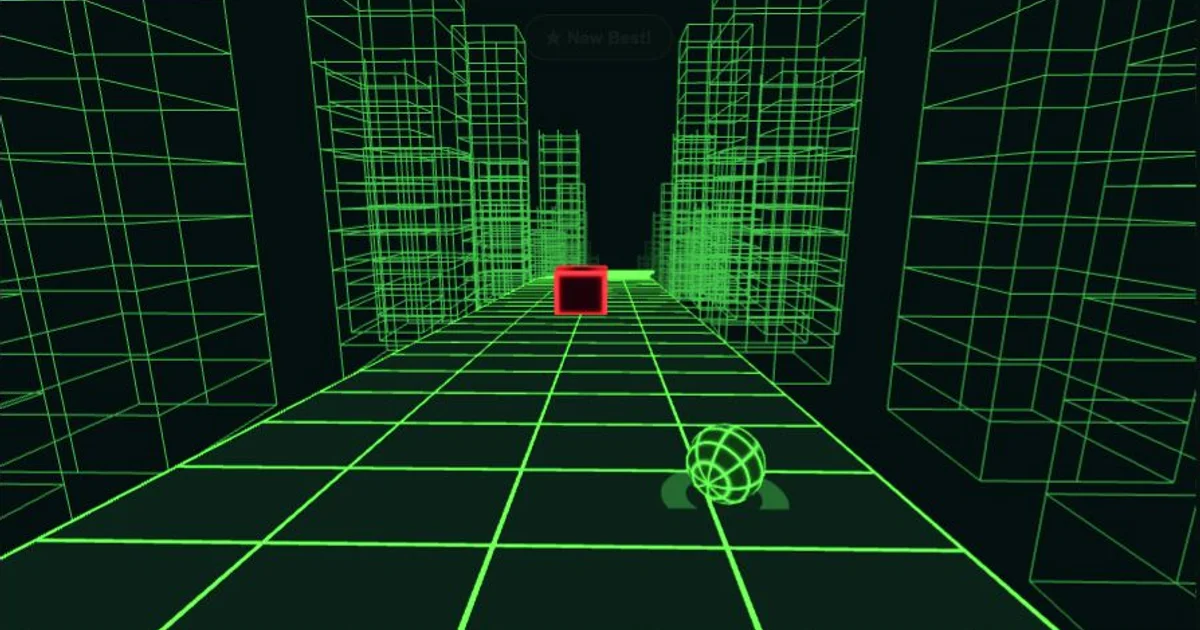
This guide covers the original Slope-style runner on OnlinePuzzle. Other versions may use different rules. Our course changes with each run, so learn the shapes and openings rather than memorizing a route.
How to play Slope: controls and rules
The ball rolls forward automatically. Keep it on the green track and avoid every red block. Touching a block or falling away from the platform ends the run. There is no finish line, level selection or extra life: the goal is to travel farther than your previous best.
There is no jump, brake or boost button. Forward speed rises as you survive; steering only changes your sideways movement. On a phone, hold the on-screen direction button briefly and release it to reduce sideways drift.
| Action | Control |
|---|---|
| Steer left / right | ← / → or A / D |
| Mobile steering | Hold the left / right button below the game |
| Pause / continue | P or the pause button |
| Restart immediately | R or Restart |
| Fullscreen | F or the fullscreen button, where supported |
| Music and effects | Separate switches in the top toolbar |
Steer smoothly instead of chasing the ball
A long press builds sideways speed. Releasing the key slows that movement, but the ball does not stop sideways instantly. If you wait until you reach the edge before releasing, your remaining drift can carry you off. Start with a short press, release, then make a smaller correction if needed.
Look one obstacle ahead while keeping the next section in view. On a curve, follow the center of the road as it shifts; the middle of your screen is not always the middle of the track. Repeated left-right corrections often create more movement than the opening requires.
- Identify the open corridor before steering.
- Move toward it with one short input.
- Release early and watch the ball settle.
- Hold your line until the block is behind you while reading the next opening.
Read all 10 track types
The course mixes different section lengths and challenge patterns. A wide platform can still contain a block, and a quiet stretch is a chance to line up for what comes next. Use the road shape and the red obstacles together to choose your route.
| Track type | What to do |
|---|---|
| Wide ramp | Use the extra width to reset your line; keep checking for red blocks. |
| Sweeping curve | Follow the road gradually instead of aiming at the screen center. |
| Narrow bridge | Line up near the center before the track narrows. |
| Split track | Choose one side before the center opens; stay on that branch until the road rejoins. |
| Gap / jump | Aim at the landing platform before takeoff; momentum carries the ball across. |
| Tunnel | Read the openings between blocks rather than the surrounding frames. |
| Slalom | Prepare for successive changes of line instead of reacting to each block at the last instant. |
| S-bend | Ease through the first bend, then prepare to change steering direction. |
| Obstacle gates | Find the open lane between the paired red blocks; watch moving edges. |
| Steep descent | Keep looking down the road as the ground drops and perspective changes. |
Worked example: pass the first red block
The opening block sits on the center line. Staying completely still will end this run early. Either side offers a route: make a small adjustment soon after starting, then release once your line clears the block. You do not need to travel all the way to the outside edge.
For example, choose the right side, move right, and release before the ball reaches the edge. Once the block is behind you, look at the next section before returning toward the center. Moving back too soon can clip the block; automatically returning to center is also wrong if the next road splits.
- See the center block and choose one side.
- Leave room between the ball, the block and the track edge.
- Clear the block fully before steering back across its lane.
Cross gaps and stop falling off the track
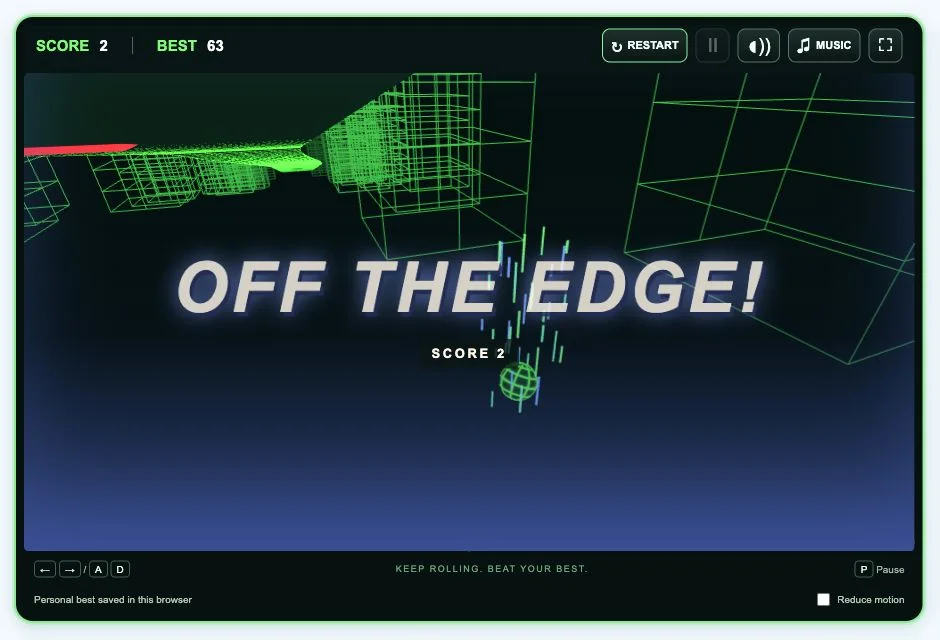
A gap is crossed by the ball’s momentum; pressing Space is not a jump command. Set your line on the approach, aim for the next platform, and avoid a large sideways change in the air. If the next section curves, use its actual landing area as your target.
A split track is different from a jump: the empty center continues along the road. Choose the left or right branch before the opening starts, then keep that line until the center becomes solid again. For a narrow bridge, do the opposite: approach near the middle and make only small corrections.
How to get a higher score in Slope
This version awards one point for every 10 distance units traveled. There are no coins or near-miss bonuses, so brushing past a block is not worth extra points. A comfortable line that keeps the run alive is the useful scoring strategy. Speed increases over time up to a limit, making earlier decisions more valuable.
Moving red blocks require you to watch their opening, not just where they were a moment ago. You cannot stop and wait for a favorable position. Start adjusting while there is space, leave a margin for the block’s movement, and avoid cutting close to corners.
Your personal best is saved in this browser when local storage is available. It is not a global leaderboard. As a practice goal, aim to beat your own recent distance consistently instead of comparing with scores from other Slope versions.
Learn from crashes and common mistakes
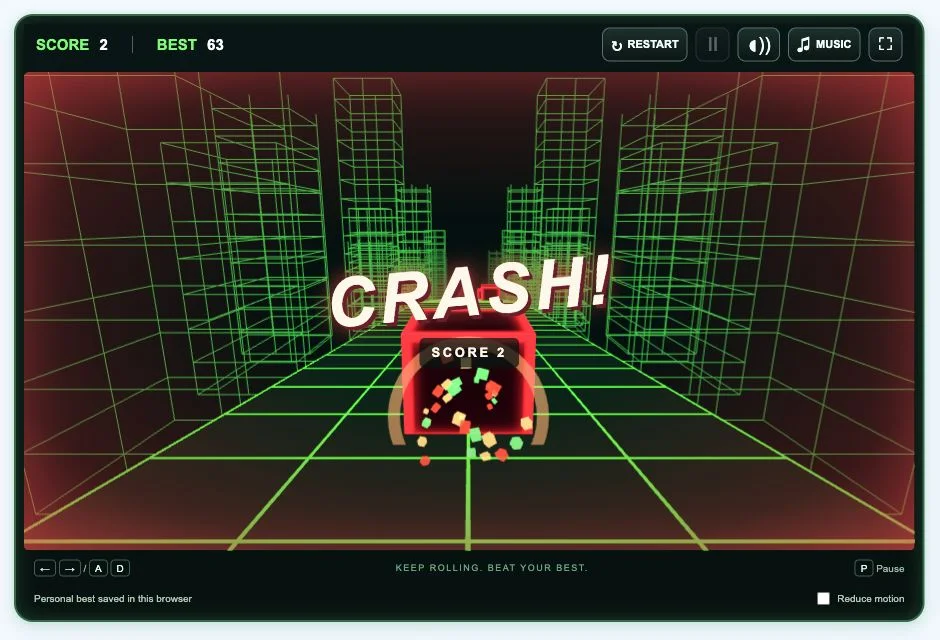
The red CRASH feedback means a block collision; OFF THE EDGE means a fall. Use the failure type to choose one change for the next attempt. Restarting with the same long steering input usually repeats the same problem.
| What happened | Adjustment to try |
|---|---|
| You hit the first center block | Steer early; the opening requires a deliberate move. |
| You avoided a block but fell immediately after | Release sooner and use less track width. |
| You hit a moving block | Leave more clearance and watch the opening as it moves. |
| You fell through a split track | Hold your chosen branch until the road rejoins. |
| You missed a landing | Align before takeoff rather than making a big correction in the air. |
A short practice plan for your next three runs
Practice one skill at a time. Because the track is regenerated, the same sequence of button presses will not solve every run. What carries over is the ability to notice an opening, enter it smoothly and prepare for the next shape.
- Run 1: focus on short steering inputs and clearing the opening block without reaching the edge.
- Run 2: name the next shape to yourself—curve, bridge, split or gap—and line up before it begins.
- Run 3: combine both habits and try to improve your own best distance.
Slope strategy questions
Can you jump in Slope Game?
In this OnlinePuzzle version, there is no jump button. The ball crosses short gaps with momentum. Line up with the landing platform before leaving the track.
Can you slow down the ball?
There is no forward brake. Releasing the steering key reduces sideways movement, not forward speed. Use P to pause when you need a break.
Should I always stay in the middle?
The center is a useful starting line on a clear ramp or bridge, but center blocks and split-track holes require you to move aside. Read the upcoming section first.
How do I get a high score on mobile?
Use short holds on the direction buttons and release before your target line. Landscape can give you a wider view of the road; choose the orientation you can read comfortably.
Is there a fixed route or final level?
No. The course is endless and changes each run. Learn the track types and steering rhythm rather than memorizing an exact sequence.