2048 strategy: keep a corner, leave yourself a move
Keeping your biggest tile in a corner is a good start. Keeping it there while leaving room for the next tile is the real puzzle. Here is a practical plan—not a promise that a lucky swipe will fix everything.
Play 2048 →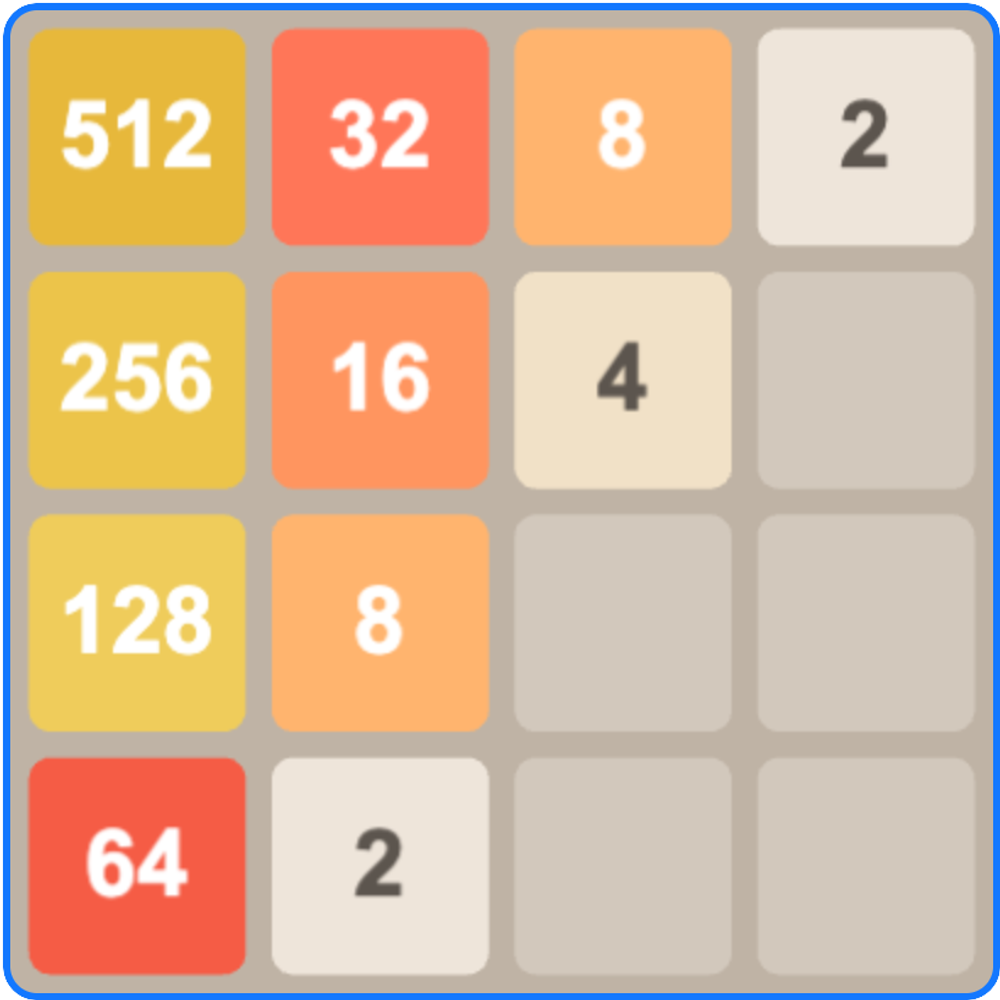
Know what one move really does
A swipe or arrow key moves every tile as far as it can in that direction. Equal tiles merge in movement order, and a tile created by a merge cannot merge again on the same move. Moving [2, 2, 2, 2] left gives [4, 4, 0, 0], before the new tile appears—not an 8. Tiles with different values cannot pass through each other.
Every move that changes the board adds one new 2 or 4 in an empty square. A direction that changes nothing adds nothing and does not count as a move. The first 2048 opens the win screen; you can continue afterward. A full board is only game over when no horizontally or vertically adjacent pair can merge. Diagonal matches do not count.
Pick a corner and build an ordered edge
We will use the upper-left corner. Try to keep your largest tile there, with the first column descending from top to bottom: 512, 256, 128, 64 is a useful example. You can mirror the idea into any corner. The goal is to bring matching tiles toward the big ones without putting a small tile between them.
Favor left and up when they preserve that shape. Prepare smaller merges in the open part of the board, then feed the bottom of the first column. This is a preference, not a rule to obey at the cost of losing the game. Inspect the whole board before each move.
A full column is useful—but not a lock
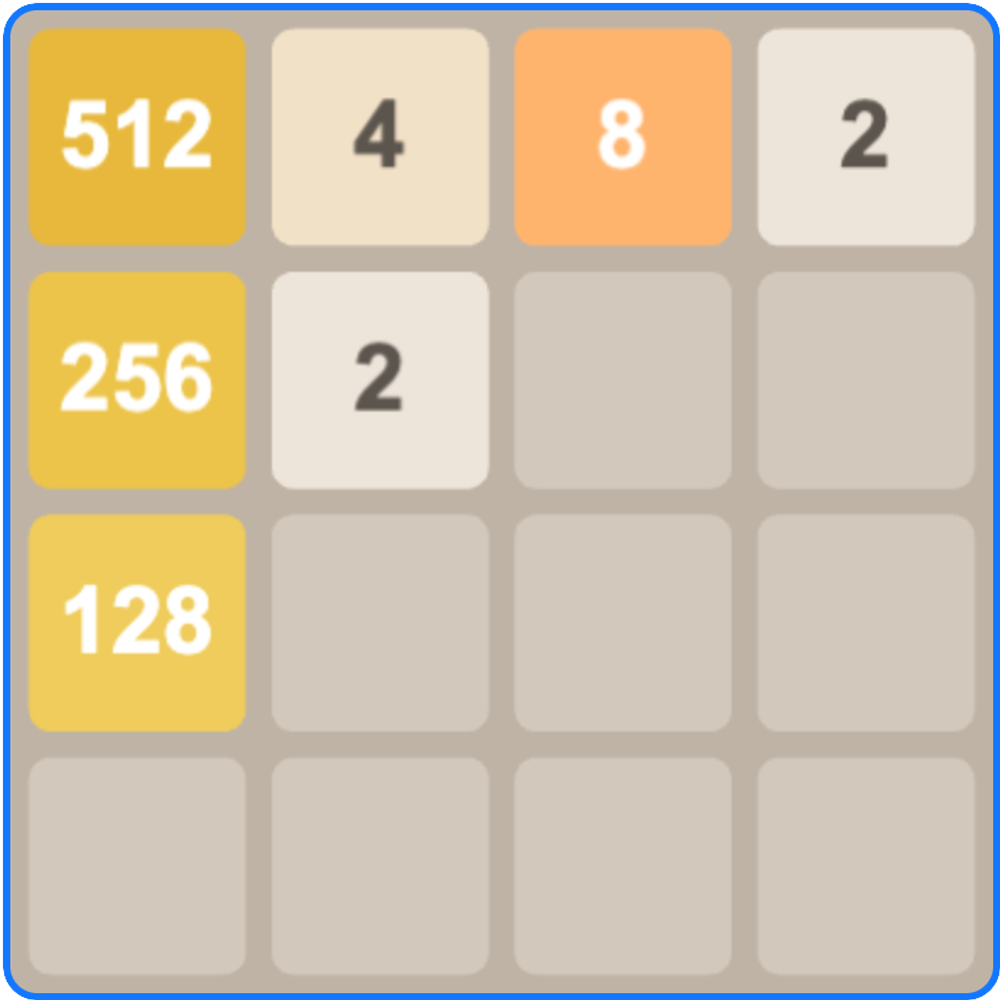
If the first column is full and has no adjacent equal tiles, moving vertically leaves that column unchanged. If it contains equal neighbors, a vertical move can merge them and change the arrangement. “Full” alone does not guarantee your largest tile stays put.
When the first column has a gap, a downward move can pull the largest tile away from the upper-left corner. A new tile may occupy the space you hoped to recover. Check that risk before pressing down; prefer a move that repairs the gap without breaking your useful merges when one exists.
Build a supply line, not a numerical speed limit
The area beside your big tiles is where smaller numbers combine. Aim to grow a matching tile close to the edge you are building. If two 16s can merge into a 32 beside the 32 you want to grow, that is usually more useful than making an isolated 64 far away. Check the next step as well as the immediate score.
There is no universal “nothing above 16 in column four” or “nothing above 32 in column three” rule. Useful values change as the board grows. A descending snake pattern can help organize tiles, but mobility and reachable pairs matter more than perfect visual order. A large tile between matching smaller tiles can make the merge harder; it does not prove the game is lost.
Count useful directions, not just empty squares
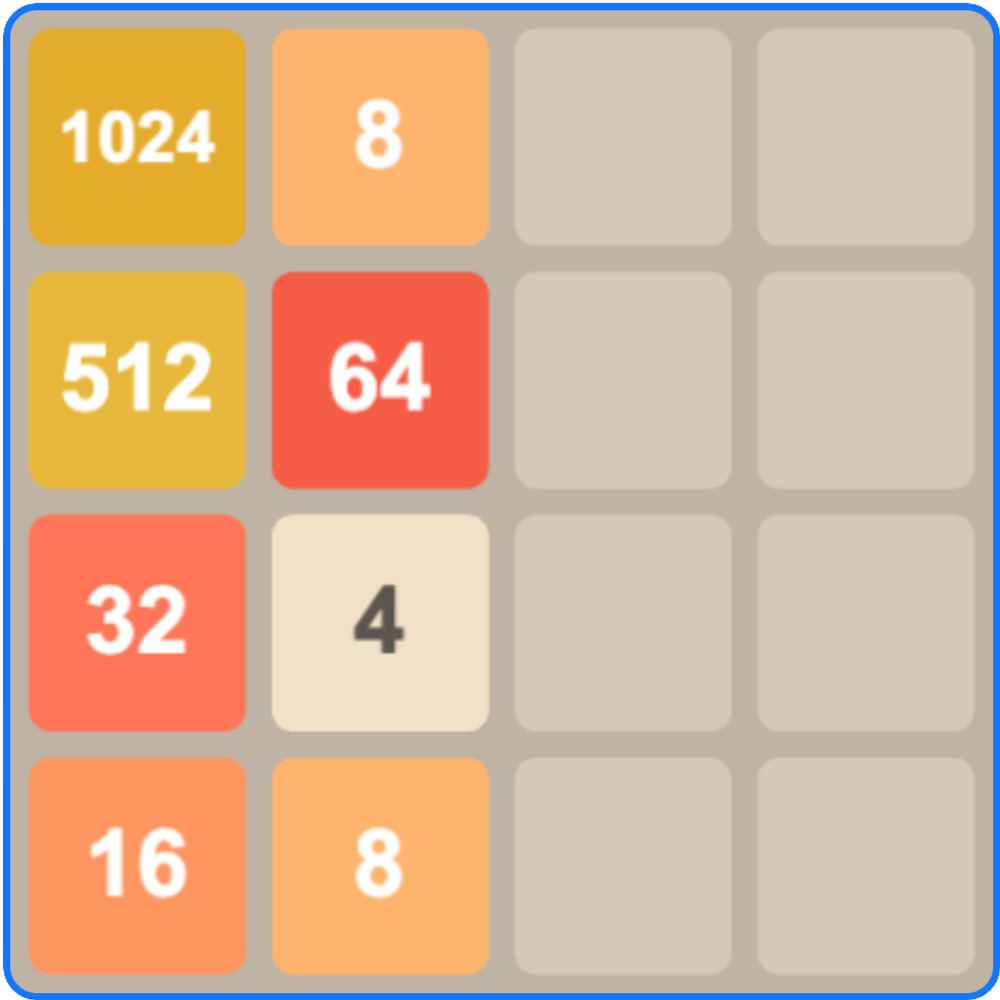
The illustrated position has plenty of empty space, yet only right changes the board. Left is already packed; both occupied columns are full and have no equal neighbors, so up and down do nothing. This is why “never swipe right” cannot be a universal strategy.
If right is your only legal move, take it and reassess after the new tile appears. It may obstruct a return to the old corner, but that is not an automatic defeat. Earlier in the game, preserve a merge or a gap that gives you another useful direction. Do not swipe up and down just to spawn more tiles: every effective move also consumes an empty square, and a move that changes nothing will not spawn anything.
Recover calmly and use Undo to learn
If the largest tile leaves the corner, stop trying to repair it at any cost. Compare the available moves: can you open space, reunite a pair, or settle the big tile along another safe edge? Breaking your preferred shape is a reason to recalculate, not restart automatically.
OnlinePuzzle offers a one-move Undo. Use it to inspect what a move changed; it is not an unlimited history or a guarantee of a favorable next tile. Before each swipe, ask: where will my largest tile go, which pair am I preparing, and what will I do if the new tile appears in an inconvenient square? Practice that routine rather than memorizing a fixed sequence.