A finished circuit needs three things: every bulb lit, every wire connected to the battery, and no loose ports. Treat the board as a network rather than a picture of a route. A glowing line is useful feedback, but it does not prove that all its exits are correct. The examples below use the rules and authored layouts of OnlinePuzzle.
Read the ports before rotating
Each connection must face a matching port on the neighboring tile. A wire touching a blank side does not conduct. Ports cannot point outside the board, into an empty cell or into an obstacle. The battery, bulbs, marked fixed wires and four-way crosses cannot rotate. A cross joins all four directions; it is not two independent bridges.
Begin with those fixed pieces. If a bulb points left, the tile immediately to its left must provide a right-facing connection. A corner beside two blocked directions may have only one possible orientation. Propagate such forced connections before trying uncertain junctions.
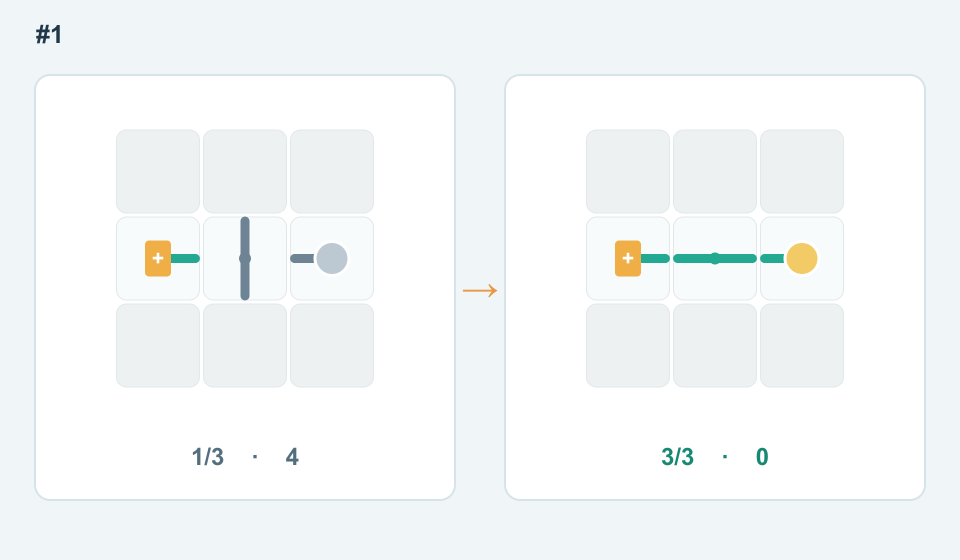
In First Spark, the center wire starts vertical. The battery and bulb face one another across it. Rotate that wire once: the two required horizontal connections appear together. The network changes from 1 of 3 powered tiles and four loose ends to all three powered and zero loose ends.
Use a repeatable branch check
- Choose a fixed port and point its neighbor back toward it.
- Follow that branch until another fixed piece, edge or junction constrains the next turn.
- At a T-junction, account for all three exits. Do not stop after finding a route to one bulb.
- After a change, inspect both the powered count and the loose-end count.
A locally neat pair can still belong to an isolated island. Conversely, a powered T-junction can have an unused third arm. These are different problems: the first needs a connection to the battery; the second needs a reciprocal neighbor or a different orientation.
Worked branch example: Two Little Lights
Level 6 has a horizontal route across row 2 and a branch down column 2. Number rows from top to bottom and columns from left to right. The battery is at R2C1; bulbs are at R2C4 and R4C2. The junction at R2C2 must connect left, right and down. R2C3 must be horizontal, while R3C2 must be vertical.
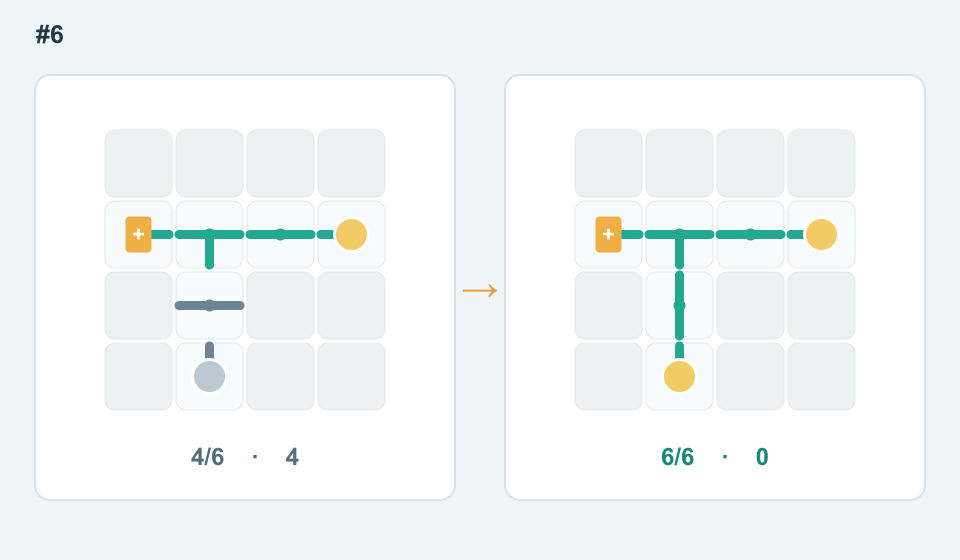
The left diagram deliberately turns R3C2 sideways while leaving the upper route correct. The right bulb glows, but the lower bulb is disconnected and ports remain unmatched. Turning the lower wire upright solves this example. This is a teaching comparison built from the level layout, not a claim that the left panel is its initial shuffled state.
Before making that turn, predict which counters will change. If a proposed move lights a bulb but leaves a third junction port loose, it is progress, not completion.
Loops are allowed, but islands are not
Some Net and NetWalk guides say never to form a loop. Do not transfer that rule here: OnlinePuzzle allows closed loops. Every tile in the loop must still connect to the battery, and every port must match. A disconnected ring with no loose ends still fails the powered-network requirement.
When stuck, examine an unpowered region from its boundary. Which neighboring tiles could connect it to the powered region? Eliminate orientations that point into obstacles first. Avoid spinning the same interior tiles without changing the region’s connection to the rest of the board.
Improve moves after solving the logic
Tap rotates clockwise by 90°. Shift-click turns backward; touch players can hold a tile for the reverse control. A needed counterclockwise turn should not cost three clockwise clicks. Straight wires have only two distinct orientations, so repeated half-turns can undo your own work.
Use Undo to compare a guess with the earlier board. Hint first identifies a wire, then shows a direction; it does not rotate for you. Three stars require the displayed move target without hints. A one-hint attempt can earn two stars only within its move allowance. Finish first, then replay for fewer rotations rather than sacrificing a sound connection to chase the counter.
Questions that come up while playing
Why are all bulbs lit but the level is unfinished?
Check unpowered wires and loose ports. Completion requires every nonempty circuit tile in the battery network and zero loose ends, not merely lit bulbs.
Can I make a loop?
Yes. A loop is valid if it is part of the single powered network and all ports match.
Is this an electrical simulator?
No. It is a connection puzzle; voltage, resistance and real-world short circuits are not modeled.
Sources and version differences
Related reading on network puzzles. Net prohibits loops; the OnlinePuzzle rules and examples above deliberately do not adopt that restriction. Simon Tatham: Net.