Find a convincing image seam, then check where the displaced cards will go. Jigsaw Solitaire is not a card-rank game and it does not use an empty sliding-puzzle square. The grid stays occupied. Moving a card or group rearranges other cards, so a promising match should be judged together with the movement it causes.
Match relationships, not just colors
Only original horizontal or vertical neighbors can join, in the correct relative position. Two blue pieces are not enough: follow a floorboard, window edge, brushstroke or object contour across the seam. A diagonal relationship does not count. Use Preview to locate a distinctive feature, then return to the board and identify its neighboring fragments.
Cards have no rotation control. You are choosing their grid positions. A correctly matched region can form away from its final location and later move as a group. Do not confuse a convincing local seam with the finished whole picture.
First level: swap the two columns
The opening painting is The Bedroom by Vincent van Gogh. Its four cards start as two connected vertical strips in reversed columns. Label the original picture’s upper-left and upper-right cards A and B, and the lower pair C and D. The initial board is B–A above D–C; the target is A–B above C–D.
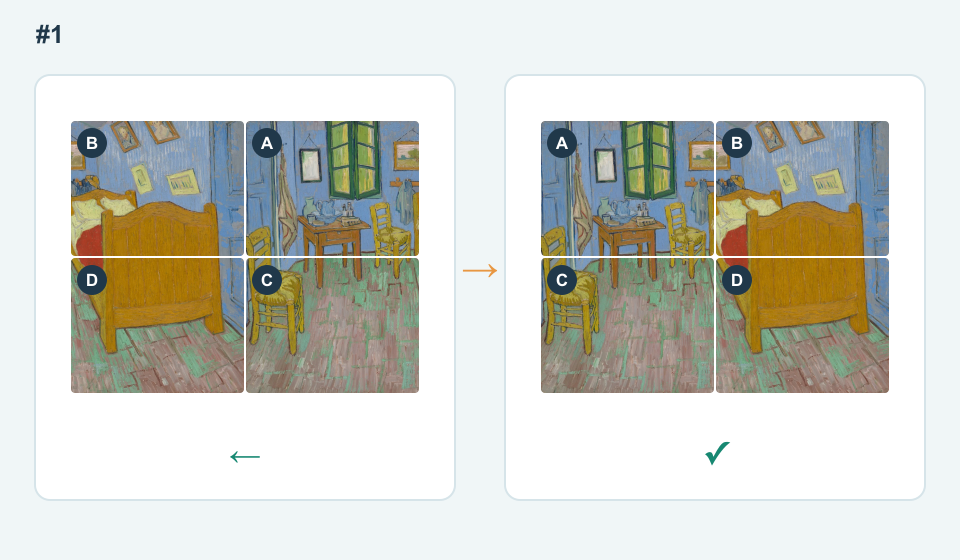
Drag the right-hand strip one column left. Both of its cards move together, the other strip fills the vacated column, and the complete painting joins in one move. This works because each vertical pair is already correctly connected. Trying to drag only the top fragment misunderstands the group you have picked up.
For later paintings, look for similarly strong seams before moving a large region. A distinctive object is often a more reliable anchor than a broad patch of nearly identical sky.
Inspect the landing footprint
The whole held group must fit within the board. A drop that would leave part of it outside is rejected. Before dragging, trace the shape of the group, not only the card under your pointer. The covered destination cells will push their occupants into cells the moving group leaves behind.
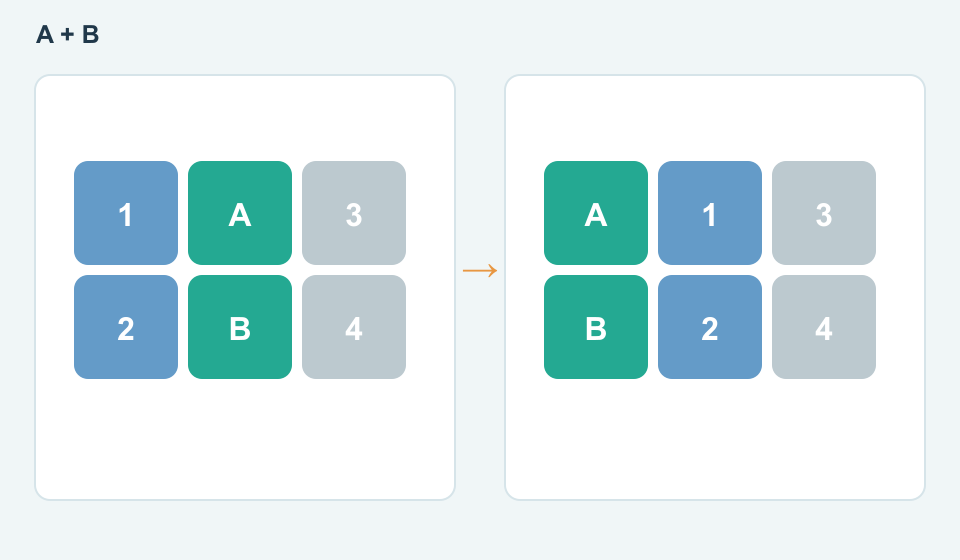
The numbered diagram is a small teaching board, not an artwork screenshot. A two-card vertical group moving one column left occupies two cells and vacates two. Its neighbors cannot remain underneath it. Check those two destination cards first: are they a useful pair, or loose pieces you can afford to rearrange?
The group you hold remains together. Other displaced groups are preserved when their entire shape fits the available vacancies; irregular overlaps can separate those displaced arrangements. If an experiment damages a useful region, Undo is better than immediately adding another poorly understood move.
Reveal information before organizing it
Later puzzles include face-down cards. Tap one to reveal it; no paid item is needed. A hidden face cannot contribute an image seam until revealed, so keeping many hidden cards merely reduces the evidence available for matching. Flips count as moves, but there is no move limit or penalty to avoid.
After a reveal, inspect both horizontal and vertical neighbors. A newly visible card may connect two regions at once. Do not move it automatically toward an assumed corner before checking those relationships.
Use a three-pass solve
- Recognize: reveal hidden cards and identify distinctive boundaries with Preview.
- Join: build small convincing regions, checking each held group’s footprint and the displaced cards.
- Reassess: after every large move, follow the newly exposed seams and update your plan.
If several fragments look alike, compare the continuation across one known boundary rather than judging an entire patch by color. At higher piece counts, zoom in to inspect a seam, then use Fit to recover the whole-board view before moving a group.
Hint highlights a card to reveal or a move to make; it does not teleport a piece or finish the painting. Use it to identify what you missed, then execute the move yourself. Completion requires every card face up and joined into the same picture group, not a visually plausible collection of separate chunks.
Questions that come up while playing
Why does a whole block move when I drag one card?
Correctly joined neighbors form a group. Picking up any member lifts that group together.
Why did another group change after my move?
Destination cards fill the vacated cells. A displaced group is preserved when its shape fits, but an irregular overlap can rearrange it. Undo restores the previous board.
Why does my drop do nothing?
Check whether the entire group fits inside the grid and whether the movement reaches a different cell. A tiny nudge or an out-of-bounds drop does not create a move.
Does Hint automatically place a card?
No. It highlights useful cards; you still reveal or move them. This differs from some other jigsaw-solitaire games.
Sources and version differences
Related reading on picture-card puzzles. Hint behavior and displaced groups differ between editions; the instructions above follow OnlinePuzzle. The first diagram uses The Bedroom (1889) from the Art Institute of Chicago’s CC0 image. Card & Puzzle: Jigsaw Solitaire.