To solve Meowdoku on OnlinePuzzle, eliminate squares that cannot hold a cat, then place a cat only when a row, column or colored region has one valid position left. Every unit needs exactly one cat, and cats cannot touch at a side or corner. Repeating those checks is more reliable than choosing a square because it looks convenient.
The rules that every placement must satisfy
Read a colored region as one complete area, even when its outline bends across several rows. It needs one cat, just as each horizontal row and vertical column does. A cat also excludes the neighboring squares around it. That final rule applies across region boundaries: two different colors do not make a touching pair legal.
The diagonal restriction concerns immediate neighbors. Cats farther apart on the same long diagonal are allowed. Do not import the rule that a chess queen attacks every diagonal square; it would remove valid candidates here.
Use a repeatable elimination loop
- Begin with a fixed or logically confirmed cat.
- Exclude every other square in its row, its column and its colored region.
- Check all touching squares, including the corners.
- Scan the affected rows, columns and regions for a single remaining candidate.
- After placing that cat, repeat the same checks before moving elsewhere.
A candidate is a square not yet ruled out, not a guaranteed answer. Check the unit with the fewest candidates first. If a unit has none, inspect your recent marks rather than forcing a cat into an excluded square.
Worked example: the first two cats in Level 1
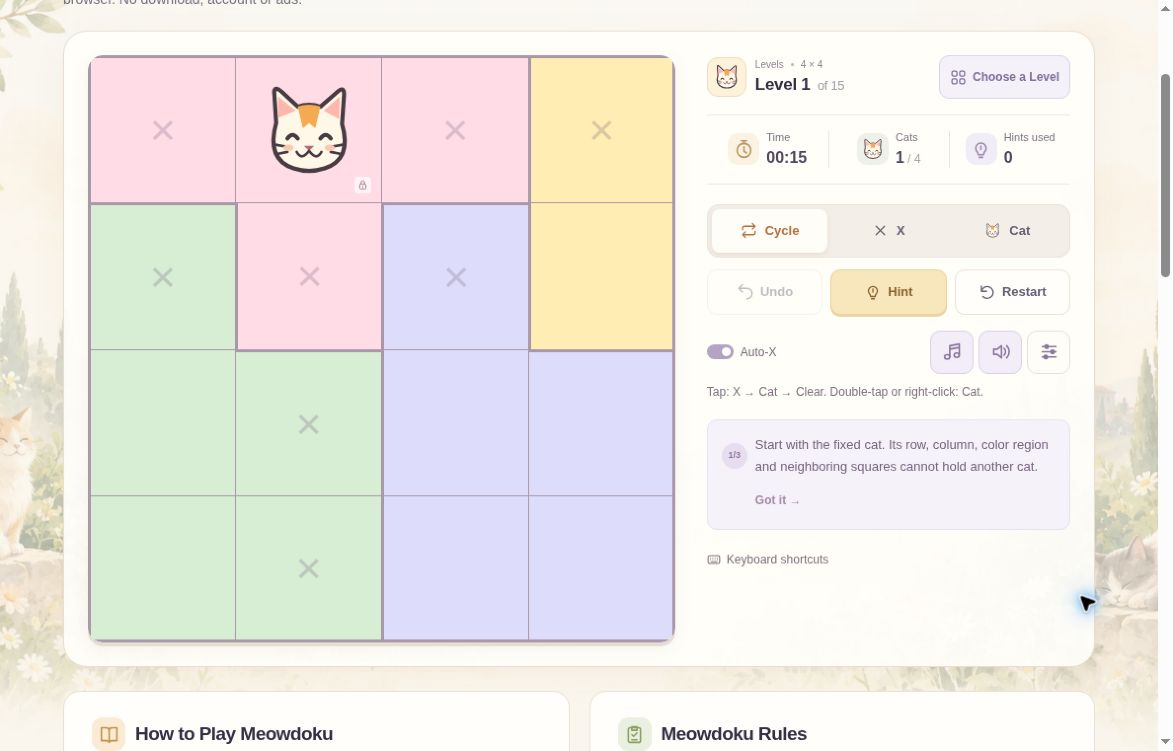
Number rows from top to bottom and columns from left to right. Level 1 starts with a fixed cat at row 1, column 2. Auto-X is enabled in these screenshots.
- Row 2, column 2 is excluded because it shares the fixed cat’s column.
- Row 2, columns 1 and 3 touch that cat at a corner, so neither can hold a cat.
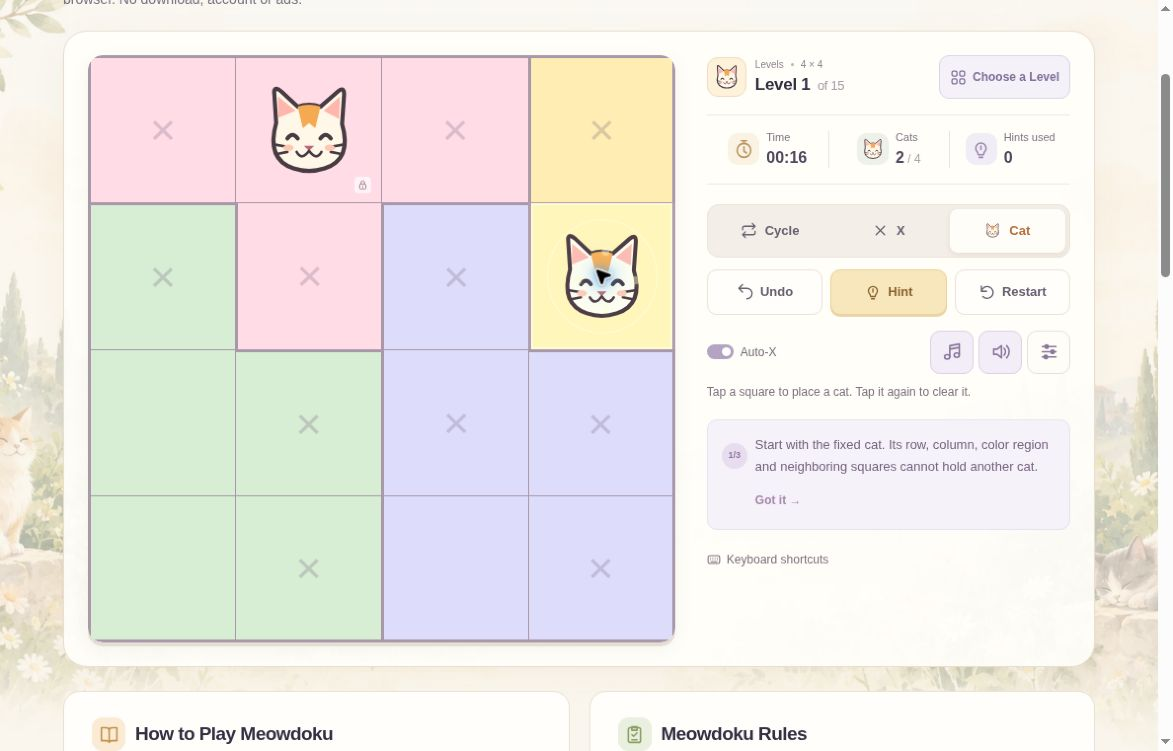
- Only row 2, column 4 remains. It belongs to the yellow region and does not touch the fixed cat, so place the second cat there.
The second screenshot shows the result. The new cat excludes row 3, columns 3 and 4; column 2 was already excluded by the fixed cat. That leaves row 3, column 1 next. One justified placement has created another.
Use a region to reserve a row or column
Sometimes a colored region still has several possible squares, but all of them lie in the same row. Because that region must contain a cat, it will supply that row’s cat wherever the final square turns out to be. You can therefore exclude squares belonging to other regions in that row without choosing between the region’s remaining candidates.
The same reasoning works for a column. Check the whole region before using it: a valid candidate elsewhere would break the argument. After making these exclusions, inspect the other regions you affected. The benefit may appear somewhere different from the region that started the deduction.
Keep marks separate from assumptions
A normal tap cycles through X, Cat and Clear. Double-tap or right-click places a cat directly. Use Undo when an input or its reasoning is uncertain. Auto-X can help display exclusions, but it does not turn a guessed cat into a proven one.
When stuck, review the last placement you could not explain. Leaving exploratory X marks behind can make an otherwise valid row appear impossible. Hint and Show Why are useful for comparing your reasoning with the game’s next step. Read the reason before continuing, so the next board feels familiar rather than simply completed.
Errors worth checking first
- Missing a corner-touching pair across two colors.
- Excluding an entire long diagonal unnecessarily.
- Placing two cats in different parts of one irregular region.
- Calling a square “forced” while overlooking another candidate.
Frequently asked questions
Can cats be on the same diagonal?
Yes, if they are separated. Two cats cannot touch at a corner, but sharing a longer diagonal is allowed.
Must every empty square receive an X?
No. X marks are reasoning aids. Completion depends on the cats satisfying every row, column, region and no-touching rule.
How many levels does this version include?
OnlinePuzzle has 15 original levels, with boards ranging from 4×4 to 8×8. It is not an unlimited generator or a daily puzzle.
How can I understand a hint?
Use Hint to find a useful area and Show Why to examine the next logical step. Compare the explanation with your current marks.
Are these official mobile-app answers?
No. The layouts belong to OnlinePuzzle’s original browser collection, not the official mobile app’s numbered levels.
Open Meowdoku and practice explaining one placement before making the next. The goal is a board whose cats satisfy all the rules, not a board filled with hurried marks.