Find the needle by comparing detector readings, narrowing the search area and removing hay only where the evidence is strongest. In OnlinePuzzle’s Needle in a Haystack, stronger signals indicate nearby metal, not necessarily the needle. This guide explains the current 10-level browser game: targeted digging, misleading scraps and tool upgrades, rather than unrelated games with the same name.
Know what counts as progress
Each level contains one real needle. Select Detector to scan a spot, then Hands to remove hay. When the needle is exposed, collect it to finish and unlock the next level. Free hands and the basic detector are enough to solve every stage; upgrades make particular tasks more convenient.
The clock records search time rather than counting down. Stars reward the proportion of hay left uncleared, so a deliberate search can beat frantic digging. Scanning lets you gather information without clearing straw. Treat that distinction as your main advantage when you want a cleaner result.
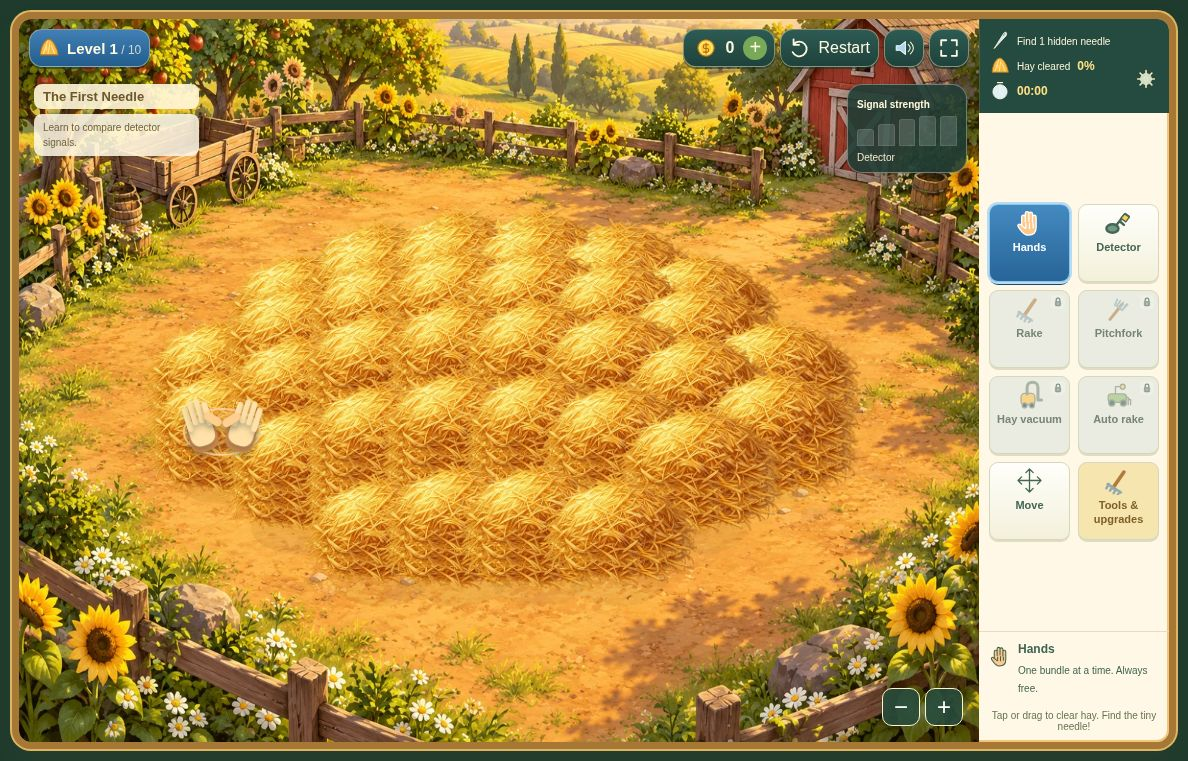
Use a broad-to-narrow search
- Compare separated areas. Scan opposite sides instead of repeatedly testing almost the same place.
- Move toward the stronger reading. Take another sample between your previous positions, then compare above and below it.
- Reduce the spacing. Once a promising patch emerges, test nearby spots before removing a large area.
- Dig and reassess. Remove a little hay, inspect what appears and scan again when the evidence changes.
Think of each reading as a clue about a neighborhood, not a precise coordinate. Two similar readings may mean you need a different comparison direction. A deep signal also matters: removing only the top layer does not prove that a promising patch is empty.
Observed example: finding a promising patch
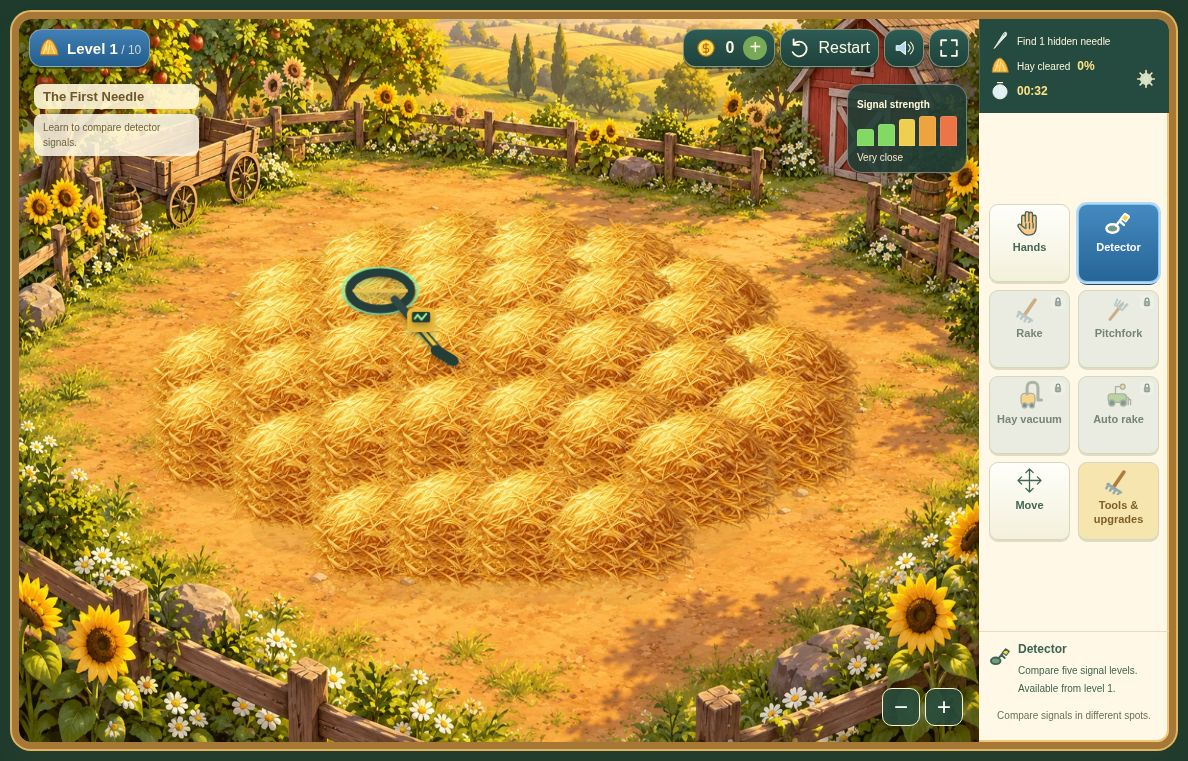
In the sampled first-level layout, the detector reported Close on the left, Far on the right and Far lower down. Moving toward the upper part of the promising area produced Very close. The second screenshot shows that reading with 0% hay cleared: the search had become more focused without removing any straw.
Switching to Hands and digging there once earned one coin and raised the displayed clearance to 3%. That test confirms the scan-then-dig sequence, not a found needle. Replays generate fresh seeded layouts, so copy the comparison method rather than the screenshot’s exact position.
Choose tools for the problem, not just the price
| Tool | Unlock | Best reason to choose it |
|---|---|---|
| Rake | Level 2; 50 coins | Clear three neighboring patches. |
| Pitchfork | Level 3; 130 coins | Remove two layers at one patch. |
| Hay vacuum | Level 5; 320 coins | Clear the top layer of a 3 × 3 area. |
| Tuned detector | Level 6; 180 coins | Read precise strength with reduced metal interference. |
| Auto rake | Level 8; 650 coins | Work repeatedly inside a selected 3 × 3 area. |
Match depth tools to a well-localized signal and area tools to a broader confirmed patch. A large tool is not automatically best for stars: it may remove more hay than necessary. One cleared bundle earns one coin, so earning upgrade money and minimizing clearance can be different goals. Keep those goals separate when deciding whether to replay.
Handle decoys without abandoning a good lead
Later levels introduce nails and metal buttons that genuinely trigger the detector. Expose and collect a scrap, then take fresh readings. Removing the interference is useful information, not proof that the whole area was a mistake. Wind can move straw without moving the needle, so do not confuse a changing surface with a relocated objective.
Avoid three common errors: clearing half the pile before scanning, leaving a strong patch after removing only one layer, and treating every strong signal as guaranteed success. Tools do not destroy an exposed needle, and auto rakes stop for collection. Take the time to inspect the cleared area.
Frequently asked questions
Does a strong signal guarantee the needle?
No. Nails and metal buttons can produce signals too. Collect exposed scraps and scan again to separate interference from the remaining target.
Can I finish without buying upgrades?
Yes. Hands and the basic detector can solve all 10 levels. Upgrades use coins earned through play, not paid purchases.
Do faster searches earn more stars?
Stars depend on how much hay you clear, not speed. The clock records your search time separately.
Is the needle always in the same place?
No. Replaying creates a fresh seeded layout. Detector comparison is more useful than memorizing coordinates.
What if the strongest patch looks empty?
Check whether deeper layers remain, then compare neighboring readings. A strong signal may come from buried metal; do not assume the first cleared layer tells the whole story.
Practice these steps in Needle in a Haystack.
Rules reference: the current OnlinePuzzle game page.