In Word Bubble, start with two words that share a clear category, then extend the accepted pair until it contains four words. A successful merge already confirms membership; it is not a provisional guess. Bubble colors are decorative, so base your decisions on meanings and the game’s feedback.
Tap one bubble and then the other to combine them, or drag one bubble onto another. After a successful merge, select the combined bubble when adding the next member.
Read the board as groups, not individual guesses
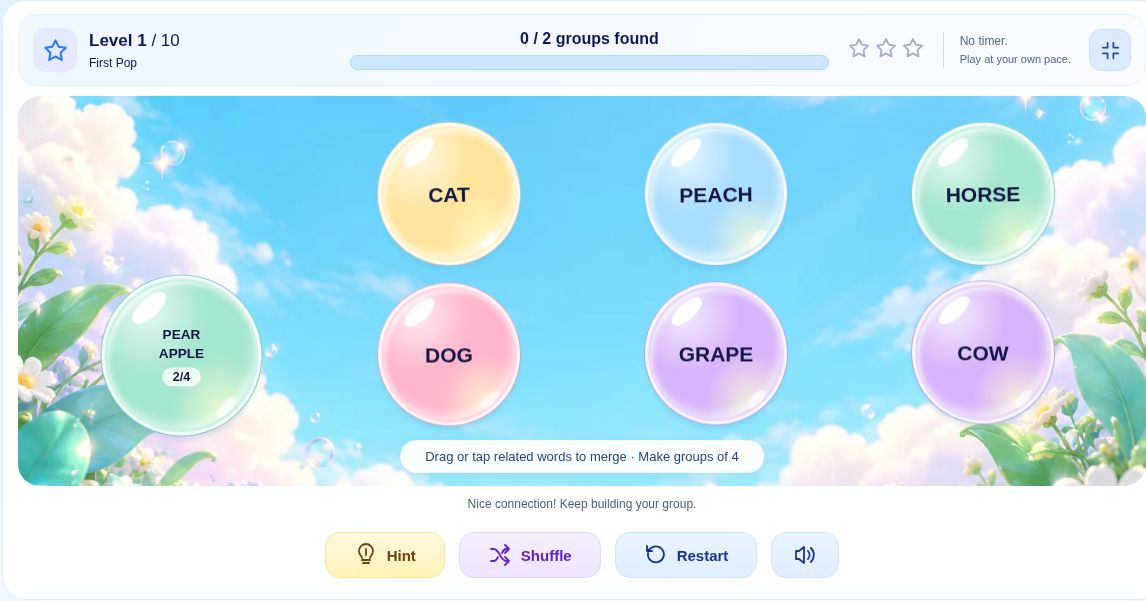
Each target category contains four words. Combining a correct pair creates a 2/4 bubble; a third member makes 3/4, and the fourth completes the category. The finished group clears and reveals its category name. A rejected addition does not break apart the correct group you have already built.
That makes a confirmed pair a useful starting point for reasoning. You no longer need to reconsider whether those two words belong together. Instead, ask which remaining words extend the same relationship. There are ten levels, and later boards can reveal additional words after you clear a group.
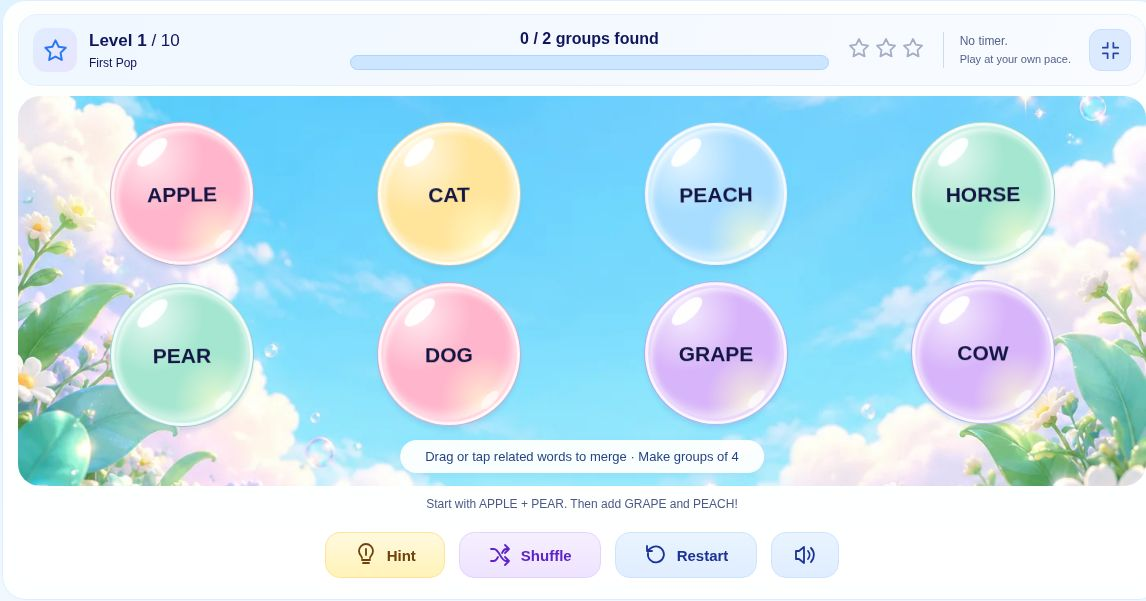
A reliable way to approach a new board
- Read every visible word once. Look for a relationship that can describe several words, rather than immediately combining the first two that sound associated.
- Name a precise candidate category. “Fruit” is a more useful test than “things found outside.” A clear definition helps you judge the next member consistently.
- Build one strong pair. After the game accepts it, use that pair as established information. Do not assume the category’s exact label has already been revealed.
- Extend deliberately. Before adding a word, explain how it fits both members of the pair. A word connected to only one member through a different meaning deserves another look.
- Scan again after a group clears. Check the remaining words and any newly revealed bubbles. The next decision should use the current board, not a list you memorized before the previous clear.
This routine is particularly helpful when a word has several meanings. You do not need an elaborate story connecting the words. Prefer a short category description that applies to every member in the same way.
Worked example: Apple, Pear, and the rejected Cow
The recorded English first level contains Apple, Pear, Grape, Peach, Cat, Dog, Horse, and Cow. Combining Apple and Pear produces an accepted 2/4 bubble. Its membership is confirmed even though the category name has not appeared.
Adding Cow is rejected. Crucially, the Apple–Pear pair remains at 2/4. The feedback says that this addition does not match; it does not say that the earlier accepted pair was wrong. Keep the pair and reconsider the candidate word.
Adding Grape advances the group to 3/4. Adding Peach completes it and reveals Fruits. Cat, Dog, Horse, and Cow form the other category, Animals. This small example illustrates the method, not a complete answer list for every level.
The rejected Cow also shows why a very broad explanation is unhelpful. Fruits and animals can both be found on a farm, but that observation does not make them members of the same target group. The game’s accepted merges provide the stronger evidence.
What to do when the obvious grouping stalls
First, separate confirmed groups from untested ideas. If a pair is accepted, preserve it and review only the words you are considering adding. If no pair is established, look for another meaning of the ambiguous word or begin with a clearer relationship elsewhere.
Shuffle can change the visual arrangement without changing the words or completed merges. Use it when proximity is steering your attention too strongly. A hint is another option when you cannot identify a useful connection; there is no timer forcing a rushed answer.
Common mistakes to avoid
- Grouping by bubble color instead of word meaning.
- Treating an accepted pair as if it still needs to be validated.
- Abandoning a correct pair because an unrelated addition failed.
- Using a broad association that changes meaning from one member to the next.
- Assuming all words for a later level were visible at the start.
Frequently asked questions
Do bubble colors identify categories?
No. Colors are decorative; use word meanings and accepted merges.
Is an accepted 2/4 pair already correct?
Yes. A successful merge confirms that its words belong to the same target category.
Does a rejected addition undo my accepted pair?
No. The correct group remains intact, so try a different addition.
When can new words appear?
From Level 7, completing a group reveals four new words. Rescan the board after each clear.
How many levels are there?
This version contains ten fixed-set levels. It is not an unlimited stream of randomly generated boards.
Start with one relationship you can explain
Play Word Bubble, find a clear pair, and let each accepted merge narrow your next decision. You only need to solve the group in front of you, then reassess the board.