A playable word is only the beginning. In LexiRelic, the better move is the word that helps you reach this stage’s target while leaving a useful rack and enough turns. You have six valid submissions and two swaps at the start of a normal stage. Spend them as a plan, not as six unrelated guesses.
Check the gap before choosing a word
Subtract your current score from the target, then compare that gap with your words left. If you need 40 points with two words remaining, a 12-point word leaves a demanding 28-point finish. That does not make it wrong, but its refill needs to justify the risk.
Invalid words do not consume a turn. Valid repeated words do: they score half, rounded down, with a minimum of one. The repeated-word list lasts for the whole adventure, not just the current stage. Do not treat a familiar word as a reliable full-price fallback.
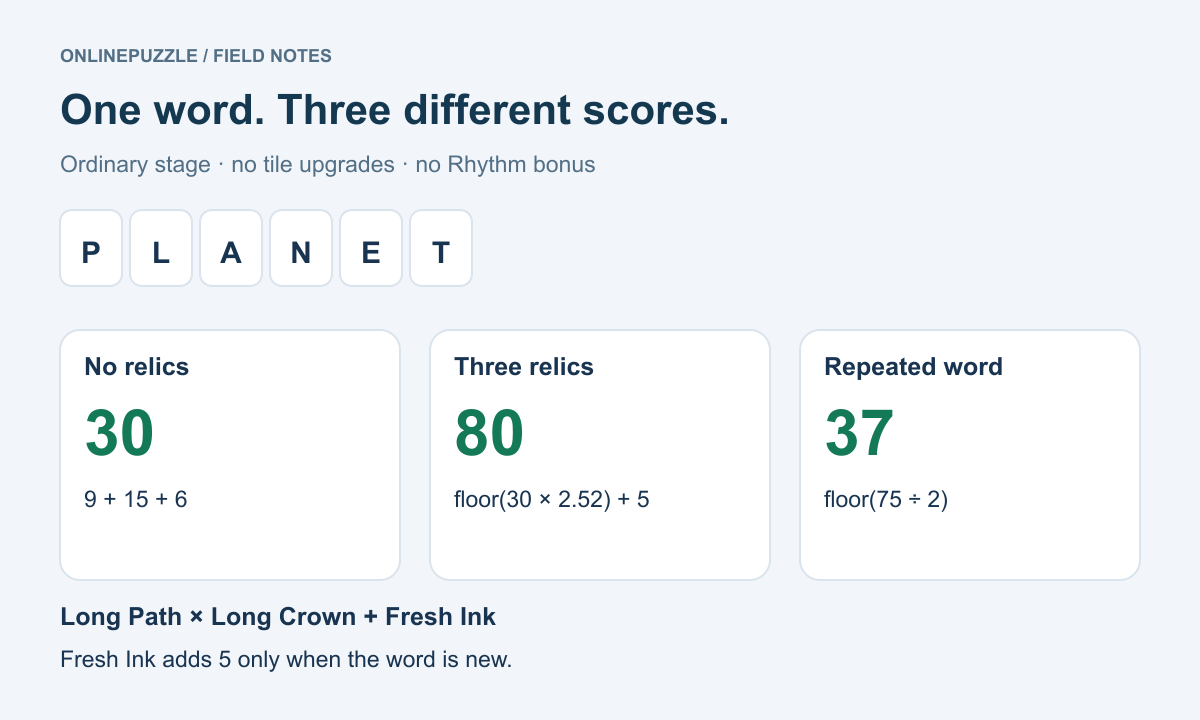
A six-letter word can be worth 30, 80 or 37
Take PLANET on unupgraded English tiles. P=2, L=3, A=1, N=1, E=1 and T=1 give 9 base points. Six letters add 15. Two vowels activate Vowel, and six different letters activate Explorer: another 6. With no Rhythm bonus, that is 30.
Long Path and Long Crown multiply the subtotal together: 1.4 × 1.8 = 2.52. The game rounds down once: floor(30 × 2.52) = 75. Fresh Ink then adds 5 for a new word, producing 80. These three relics fit within the four-slot limit.
If PLANET has already been used, Fresh Ink contributes nothing. With the same other conditions, the repeated word gives floor(75 / 2) = 37. A small change in word history can matter more than another high-value letter.
Choose relics you can actually activate
A multiplier that never triggers is not a build. Long Crown needs at least six letters; Perfect Seven needs seven. Short Story and Fourfold can make short words useful while you assemble stronger combinations. Compare the displayed result for the words available now, rather than choosing every item with a large multiplier.
The core subtotal is base value plus length bonus plus sigils. Multipliers affect that subtotal; extras such as Fresh Ink are added afterward. Therefore an extra five points is not automatically multiplied by all your relics.
A fifth relic replaces one of your four equipped relics. Before replacing a dependable bonus, check whether the new one works with your rack size, common word lengths and the next boss. Extra Pocket gives eight tiles to choose from, but words still use at most seven.
Do not throw away Ink Leech’s opening turns
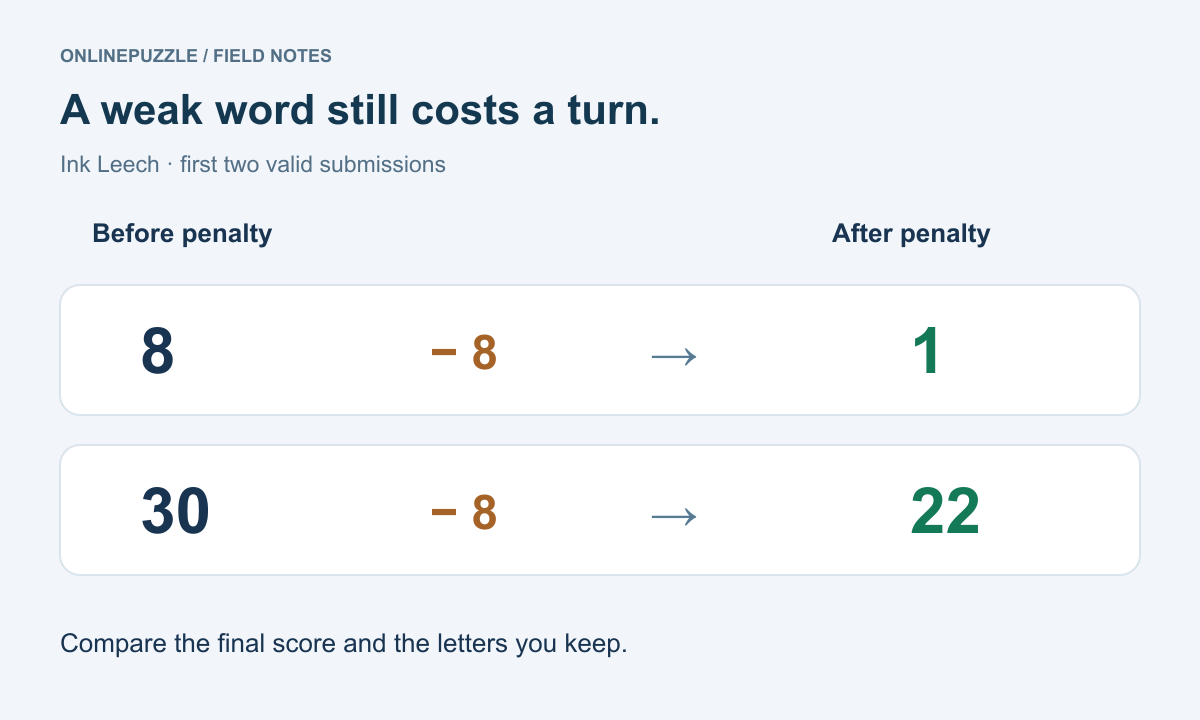
Stage 6 subtracts eight points from each of your first two valid words, with a minimum result of one. It can be tempting to sacrifice tiny words. But an 8-point word becomes 1 while a 30-point word becomes 22: both lose almost the same amount, and the stronger word still advances the target much further.
A short opening can still be sensible if it preserves upgraded tiles or refills awkward letters. The reason must be the whole position, not simply “the boss penalizes this turn.”
| Boss | What changes | What to check |
|---|---|---|
| Stage 3: Vowel Warden | Three-letter words lose 20% of base points, rounded up; words of five or more get +5. | Compare the final score, not just the word length. |
| Stage 6: Ink Leech | The first two valid words lose 8. | Do not spend a scarce submission just to absorb a fixed penalty. |
| Stage 10: Mirror Scribe | Odd turns favor 3–4 letters; even turns favor 5–7. Only the length bonus doubles or halves. | Check turn parity before submitting; the entire score is not doubled. |
Use swaps and coins to solve the next bottleneck
Select only the tiles you want to exchange. Keeping a vowel is a useful default, not a command: if your best scoring pattern needs consonants, preserve those instead. Shuffle rearranges the rack without changing its letters. A free rescue supplies a playable common word only when the rack has none; it does not promise a word that clears the target.
You earn five coins plus two for every unused submission when you clear a stage; a boss adds five. Saving words can therefore help the next shop. Shops follow stages 2, 4, 6 and 8. A supply purchase costs four coins and adds one submission and one swap to the next stage. It does not rescue a stage already lost.
Before every submission: check the target gap, preview the score, notice repeat status, inspect the boss turn, and look at the letters that will remain. Free hints suggest common playable words; they are a way to discover an option, not a proof that the entire run can be won.
Questions while playing
Does a long word always beat a short one?
No. Relics, sigils, repetition and the boss rule can change the comparison. Use the actual score breakdown.
Do Letterlike strategies transfer directly?
Only broad ideas such as combining bonuses. LexiRelic has its own four-slot limit, ten stages, scoring formula and bosses; Letterlike upgrade prices and progression do not apply.
Will every seed be winnable?
This guide does not claim that. Rescue guarantees a common playable word, not a winning sequence. Replay seed repeats the initial state and random sequence when you repeat the same actions.
Further reading
These references explain related puzzle ideas. The rules and worked examples above are specific to OnlinePuzzle; the illustrations are original diagrams, not screenshots.