The goal is not to find as many words as possible. Logic mode asks for a particular set of hidden answers that uses all 16 letter tiles. A real dictionary word may be irrelevant to that set. Read the clue, count its letters, and use each confirmed answer to shrink the problem.
Know which mode you are solving
In 16-Letter Logic, select tiles in any order; neighboring positions do not matter. A correct hidden answer removes its letters. A different dictionary word leaves the board unchanged, and repeating a found answer does not remove another copy. Each repeated letter is a separate physical tile.
Quick Scramble is different: it asks for one anagram using the presented letters, accepts dictionary anagrams, and submits automatically when the last letter is chosen. It is untimed. Do not apply those acceptance rules to the multi-answer Logic board.
Choose the most constrained clue, not always the shortest
The shortest word is a convenient starting point, but not a law. Compare the visible prefix, shown length and rare letters. A five-letter clue containing a rare letter can be easier than a three-letter clue with many candidates. Later chapters reveal less information, so use the information that is actually displayed.
Before playing a candidate, mentally subtract its letters. Does the remaining pool still support the other clues? This is a check on your reasoning, not a risk of permanently ruining the board: the game does not consume letters for a non-answer.
Keep multiplicities explicit. APPLE needs two Ps, not one reusable P. If a potential word needs three Es and the pool contains two, reject it immediately, however familiar it sounds.
A complete Level 1 solve
The English first level shows S__ (3), B___ (4), A____ (5) and T___ (4). Its answers total 3 + 4 + 5 + 4 = 16. The illustration groups the shuffled letters for readability; it is not a screenshot or a required selection order.
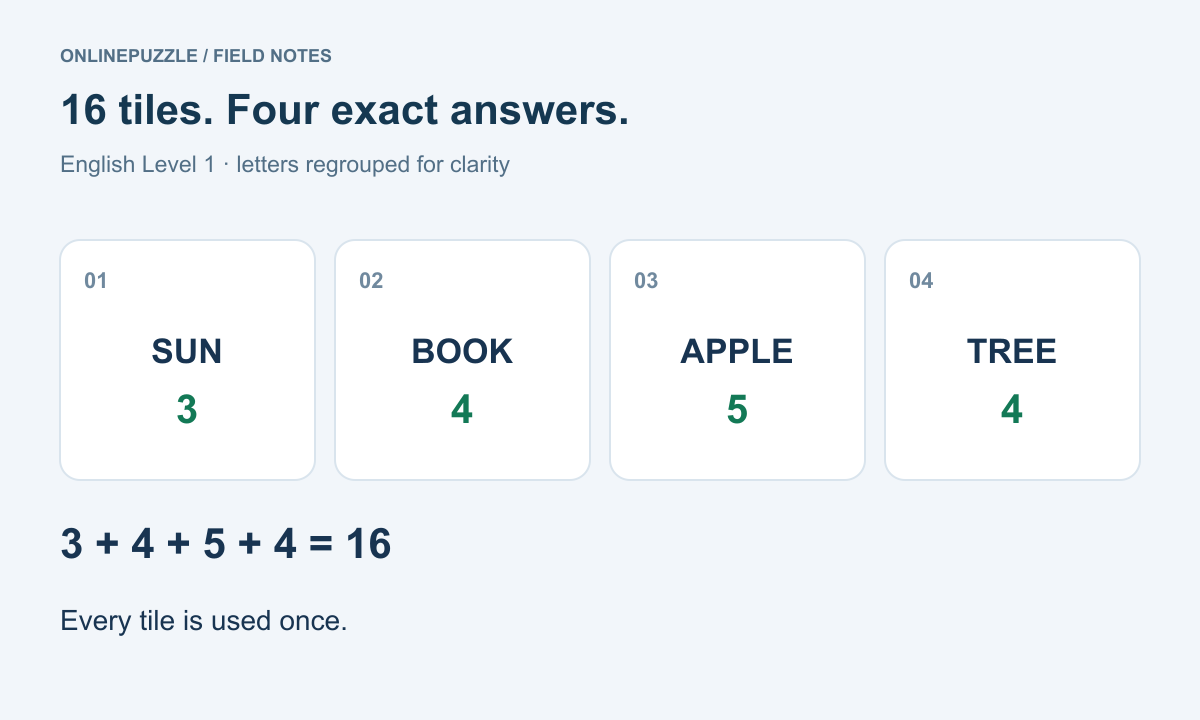
- Find SUN for S__ and submit it. Exactly three tiles leave, so thirteen remain.
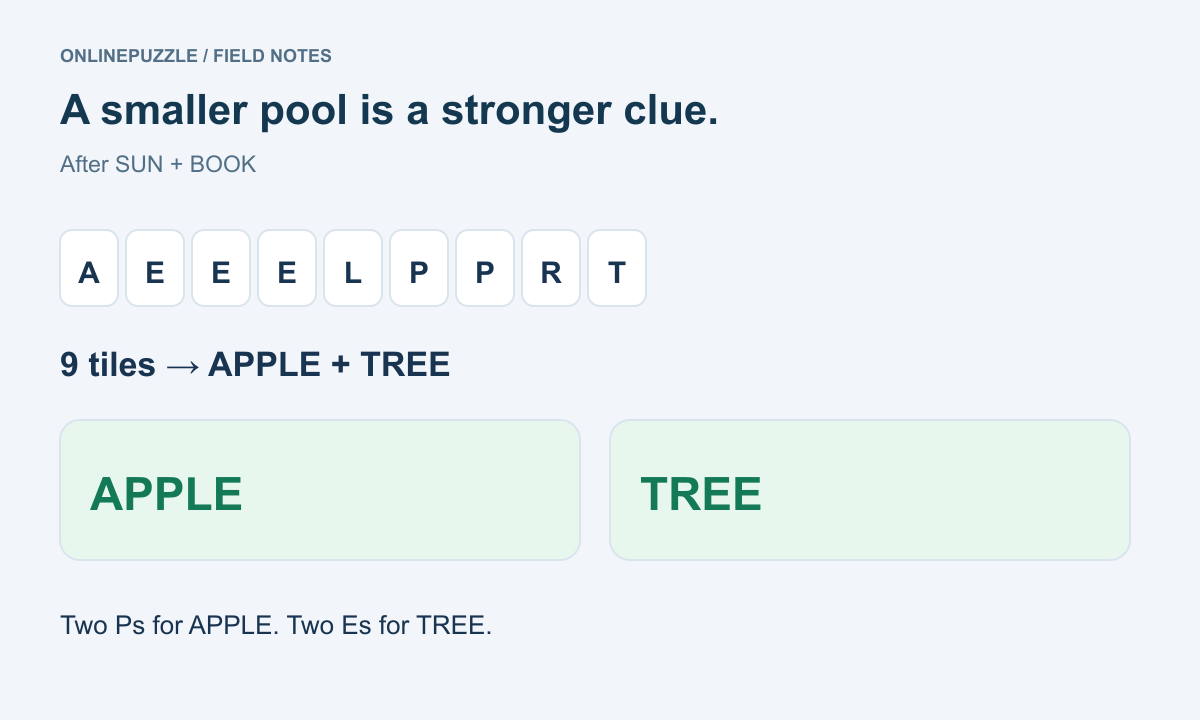
- BOOK fits B___ and uses two O tiles. After it is accepted, nine letters remain: A, E, E, E, L, P, P, R, T.
- APPLE fits A____. It consumes A, P, P, L and one E, leaving E, E, R, T.
- TREE fits T___ and consumes the final four letters. The board is complete.
You could confirm these four answers in a different order. The lesson is not memorizing SUN first; it is using the remaining letter counts as a second set of clues.
Make a small deduction before using a full hint
With APPLE still unsolved, two Ps are a useful signal. Ask which remaining clue can absorb both. With only E, E, R and T left, starting letter T distinguishes TREE from other arrangements. The clue does work that the letter pool cannot do alone.
On English Level 2, the pool contains two Zs and a five-letter P clue. That makes PIZZA a strong candidate. After it is confirmed, the rare letters no longer distract you from SKY, PEA and SOUTH. This is why a longer, restrictive clue can be a better opening.
A rejected dictionary word does not prove its letters are useless. It tells you that particular spelling is not a hidden answer. Recheck the prefix and length, then try a different arrangement or a different clue. Do not keep sending the same word.
Use the timer as an option, not a barrier to learning
Logic levels 1–10 start with 60 seconds, 11–20 with 90, and 21–30 with 120. Reaching zero ends the round. Turn the timer off while learning to count the shared pool; switching to Quick Scramble pauses the Logic timer.
A progressive hint reveals more of a selected answer, eventually the whole word, but it does not play that word for you. Use the new prefix with the remaining letters before requesting another reveal. Hints mark the attempt assisted; they do not lock other levels.
Try a second run with no hint and explain each choice to yourself: which clue narrowed it, which duplicate mattered, and what remained? That habit transfers to later puzzles much better than memorizing a list of answers.
Questions while playing
Why did a real word leave the board unchanged?
Logic mode only removes the hidden target words. A valid non-target word is different from an invalid spelling, but neither consumes tiles.
Must letters touch?
No. You may select them from anywhere. What matters is the letter count, not a path across the board.
Are the answers identical in every language?
No. English, Spanish and Brazilian Portuguese have separate puzzles. Accents, Ñ and Ç must be matched to the displayed tiles in this game.
Further reading
These references explain related puzzle ideas. The rules and worked examples above are specific to OnlinePuzzle; the illustrations are original diagrams, not screenshots.