To solve Word Tiles, combine the answer lengths with each tile’s remaining-use counter. You may choose letters from anywhere on the board; they do not need to touch. The challenge is finding the target words while allocating the available tile uses correctly across all answers.
Read the three kinds of information
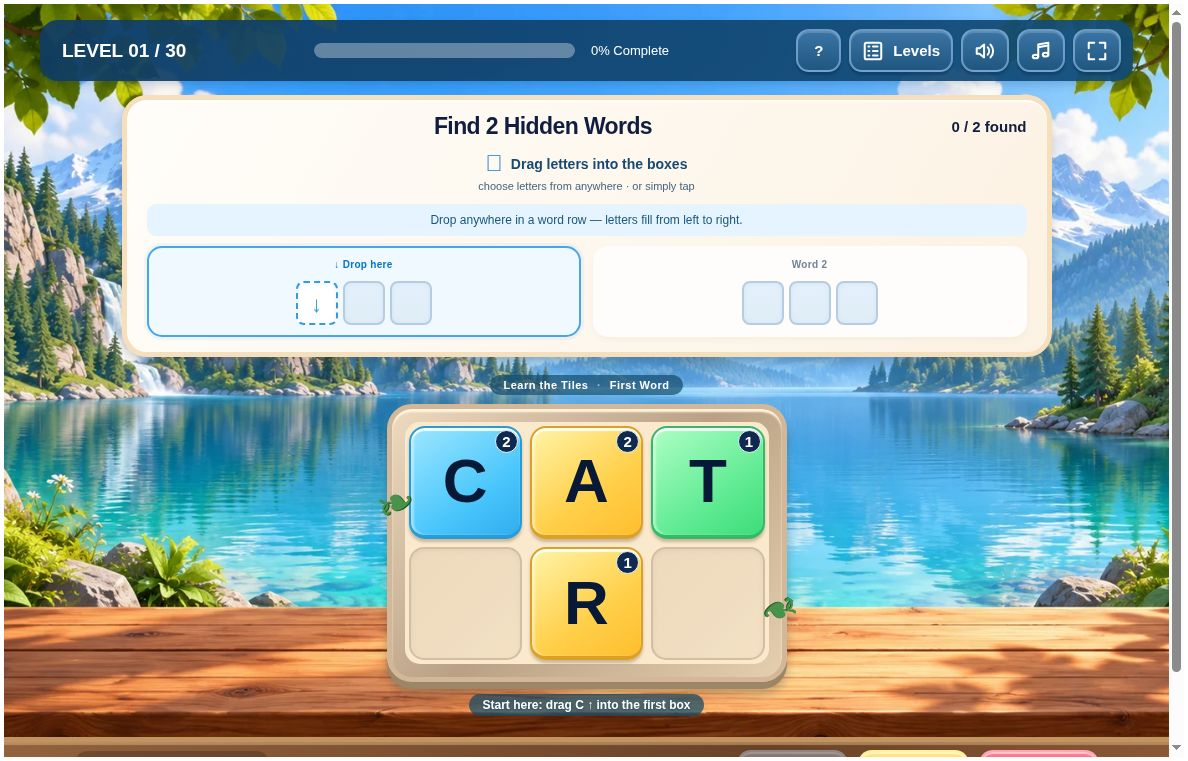
The answer rows show word lengths and any revealed letters. The board supplies the letter tiles. Each tile’s number shows how many uses remain across the unfinished answers. A tile can be used only once within a single word, even when its counter is greater than one.
Drag a tile into a word row to fill its next empty box, or tap it to fill the highlighted row. A complete word checks automatically. Placing a draft letter reduces its counter immediately; removing it restores that use. This is why the numbers can change before a word is accepted.
Completing a level requires the target answers and all required tile uses. A familiar dictionary word may instead be a bonus word. Recognizing a word and solving the target allocation are related, but they are not the same thing.
A useful order for solving
- Count the answer spaces. Note which rows are short or long and which already contain a clue. Avoid forming a word first and only then checking whether it fits.
- Inspect the tile counters. A tile marked 1 belongs to one remaining answer. A tile with several uses must contribute across multiple words, not repeatedly within one word.
- Combine constraints. Look for a word that fits the row, uses available letters, and leaves a sensible supply for the other rows.
- Check the remainder after acceptance. The new counts are clues for the next answer. When only one row remains, its letters must account for all required uses still available.
- Reconsider the physical tile when letters repeat. If the board has separate copies of the same letter, they are separate resources. Try another copy if one selection would leave insufficient uses for the remaining targets.
Worked example: the CAT and CAR opening
The recorded English first level has two three-letter answers and four tiles: C2, A2, T1, and R1. Because a physical tile can appear only once in each word, C and A must each be used in both answers. T and R each supply one remaining use.
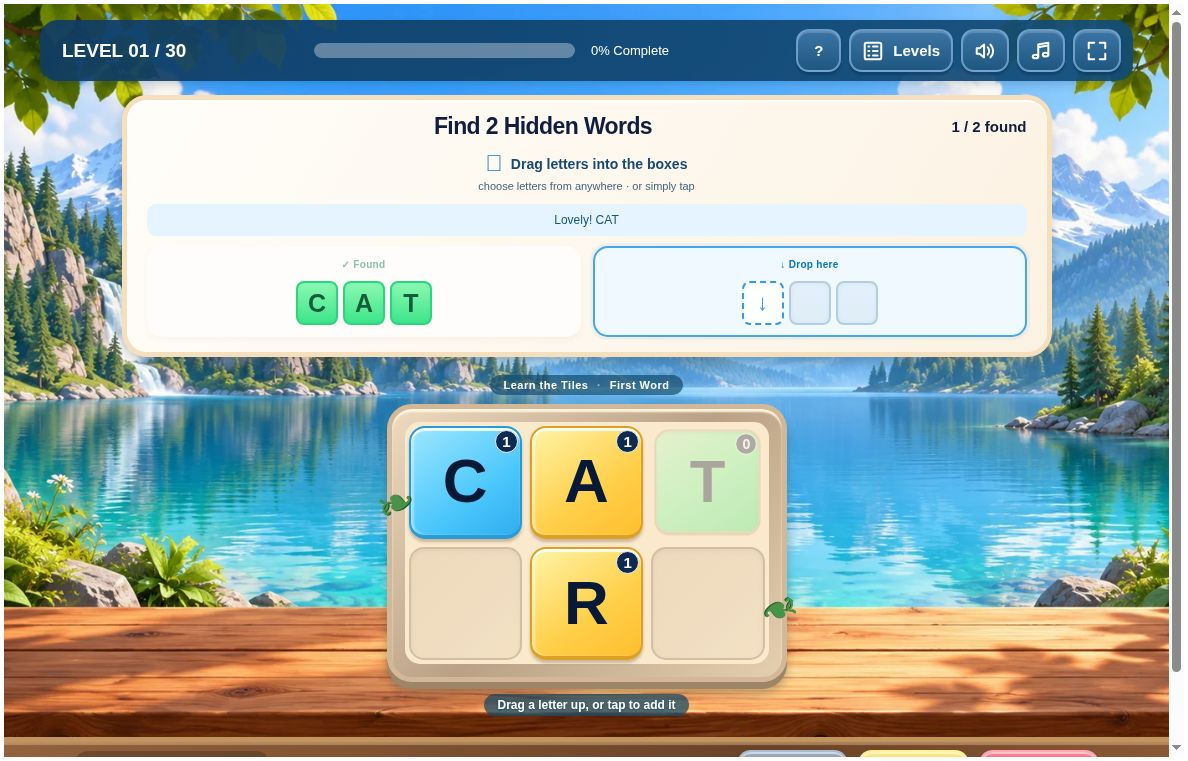
Entering CAT is accepted. The counters then become C1, A1, T0, R1. That leaves C, A, and R for the final three-letter answer. Entering CAR completes the level.
The counts constrain the letters, but not their order by themselves. This example does not establish that every other arrangement is invalid English or explain how every dictionary word would be classified. Use the game’s feedback to distinguish a required answer from an extra word.
Use bonus words, Undo, and hints for the right purpose
Bonus words are accepted dictionary words outside the target answers. They do not consume counters or replace required solutions, and repeating a bonus word does not add another entry. The Bonus Words area includes a separate way to build extra words of different lengths.
Undo removes the latest draft letter. With an empty draft, it can restore the last accepted target word. Use that distinction to correct a selection without unnecessarily restarting the level. Restart clears the current attempt while keeping unlocked levels.
A hint displays a word above the answer boxes and numbers the matching tiles on the board. Study both parts: the letter order tells you the word, while the numbered tiles can resolve which physical copy to choose.
Common mistakes to avoid
- Assuming letters must be adjacent or connected by a line.
- Reading a counter of 2 as permission to use one tile twice in the same word.
- Ignoring a changed counter because the current word is still a draft.
- Expecting a bonus word to fill a required target row.
Frequently asked questions
Do tiles have to touch?
No. You may select available tiles from any row or column. There is no adjacency or connecting-path requirement.
Can I use a tile marked 2 twice in one word?
No. Its uses are spread across different words. A physical tile can be selected only once within a word.
Do bonus words consume tile counts?
No. They are recorded separately and do not replace the required target answers.
Is there a time limit or penalty for a wrong attempt?
No. There is no timer or penalty for incorrect attempts, so you can examine the counts before trying again.
How many levels are available?
There are 30 levels. Progress is saved in the current browser, and completed levels can be replayed.
Let the remaining counts guide you
Open Word Tiles, read the answer lengths, and check the counters before building a word. After every accepted answer, start again with the smaller set of remaining uses.