To improve at Wordle Unlimited, turn each result into constraints before typing again: keep correct positions, move misplaced letters, and count repeated letters carefully. Then choose a word that tests a useful uncertainty. This guide covers OnlinePuzzle’s five-letter game, including its progressive hints and the difference between Normal and Hard mode.
Understand what a result actually tells you
You have six valid guesses to identify a five-letter answer. Completed words check automatically; an incomplete or unrecognized word does not spend a turn. Green ✓ fixes a letter in that position. Yellow ↔ confirms a letter but rejects that position. Gray − means there is no remaining copy to match after the other tiles are accounted for.
Read the complete row before eliminating a letter. If your guess contains exactly two E tiles, one yellow and one gray, E is not absent: the answer has exactly one E. This distinction matters more than memorizing a long list of opening words.
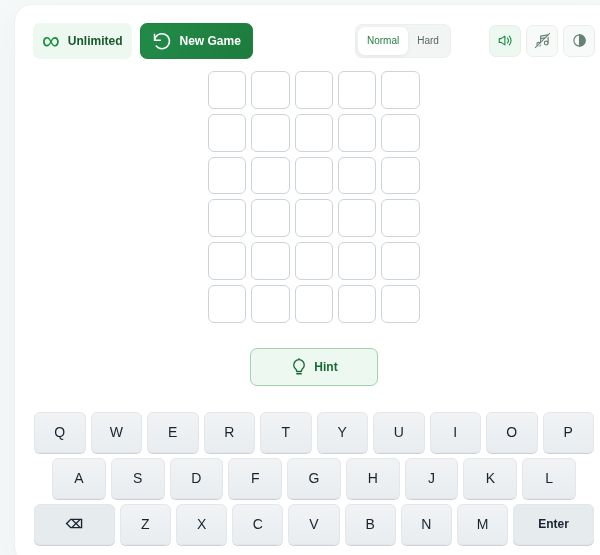
A practical guessing routine
- Open with a word you know. Favor different letters and a mix of vowels and consonants. The purpose is a readable first set of clues, not a supposedly unbeatable opening.
- Write the fixed pattern mentally. Keep greens in their exact places. For each yellow, note where it cannot go. Track a confirmed quantity when a guess repeats a letter.
- Make a short candidate list. Ask which familiar words satisfy every clue, rather than which words merely contain the latest yellow letter.
- Choose the next question. If candidates differ mainly in one consonant, testing several relevant consonants may help more than repeating known information. In Normal mode, an accepted information-gathering word can be useful even if it cannot be the answer.
- Recheck before completing the word. Does your choice contradict an earlier row? With few guesses left, favor a plausible answer over a broad test that would leave insufficient turns to finish.
A good test separates the possibilities you actually have. A word packed with unused letters may look efficient but reveal little about a shortlist that differs elsewhere. Change your plan as the board becomes more specific.
Worked example: turn two rows into a usable pattern
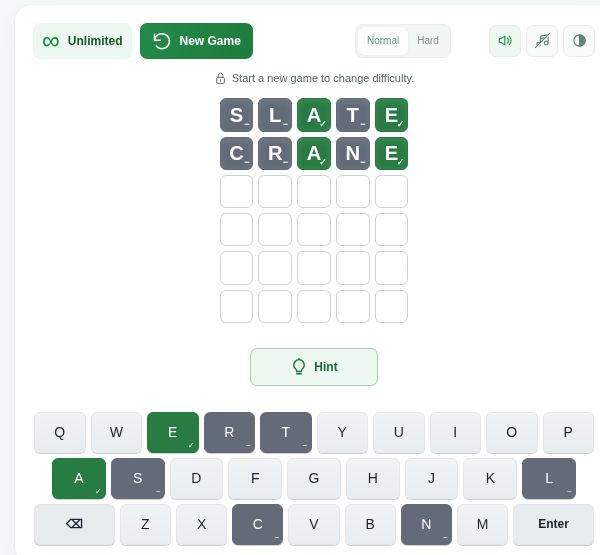
In the recorded English Normal round, SLATE returned gray S, gray L, green A, gray T, and green E. The next guess, CRANE, kept the confirmed positions while testing three different consonants. C, R, and N were gray; A and E remained green.
The resulting pattern is __A_E. Any candidate answer must place A third and E fifth and exclude S, L, T, C, R, and N. A sensible next step is to list words satisfying all those conditions, then choose which remaining uncertainty to test.
These guesses did not test duplicate letters, so they do not establish that A and E occur only once. They also do not prove a unique answer. No hint was used and the answer was not revealed in this example; the useful result is a clearer set of constraints, not a claimed solution.
Choose a mode and use hints deliberately
Normal allows any accepted word. Hard requires you to keep greens, relocate yellows, and reuse confirmed letters in sufficient numbers; revealed hint letters must also stay put. Choose before your first input or hint. Deleting your entry or refreshing does not unlock that choice.
Hints move from meaning to structure and then reveal unknown positions. Pause after each clue and apply it to your candidates before requesting another. This preserves more of the deduction while still helping when vocabulary, rather than logic, is the obstacle.
Common mistakes to avoid
- Treating one gray duplicate as a ban on that entire letter.
- Following only the latest row and forgetting an earlier excluded position.
- Using a vowel-heavy word automatically when the remaining uncertainty is consonants.
- Starting a new round merely to pause: leaving or refreshing preserves the active puzzle, while abandoning it through New Game counts as a loss after confirmation.
Frequently asked questions
Does a hint use a guess?
No. Hints do not consume guesses. The game records assisted and unassisted wins separately.
Can I change Hard mode during a round?
Not after typing the first letter or using a hint. Begin a new game to choose another mode.
Does gray always mean the letter is absent?
No. A gray duplicate can mean that another copy already accounts for the answer’s entire supply of that letter.
Is this the official daily Wordle answer?
No. OnlinePuzzle runs independent puzzles rather than the official daily Wordle. There is no daily round limit.
Can I play in Spanish or Portuguese?
Yes. The language menu leads to separate word collections and clues. This article’s SLATE and CRANE example comes from the English game.
Put the clues to work
Before your next guess, state one thing you know and one thing you want to learn. Then open Wordle Unlimited and choose a word that respects the first while testing the second.