Minesweeper tips: less guessing, more “I knew that”
Minesweeper looks innocent: a few squares, a few numbers, one very confident click. Then boom. If you know the rules but still treat every covered cell as a personal betrayal, welcome. Here are the patterns worth learning before blaming your mouse.
Play Minesweeper →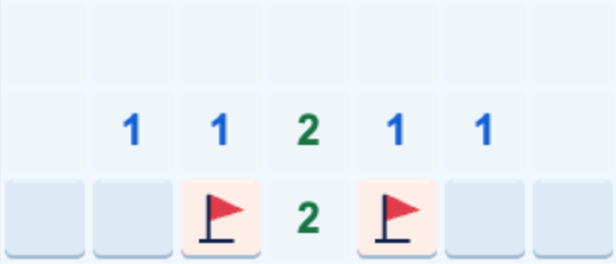
First, make friends with the controls
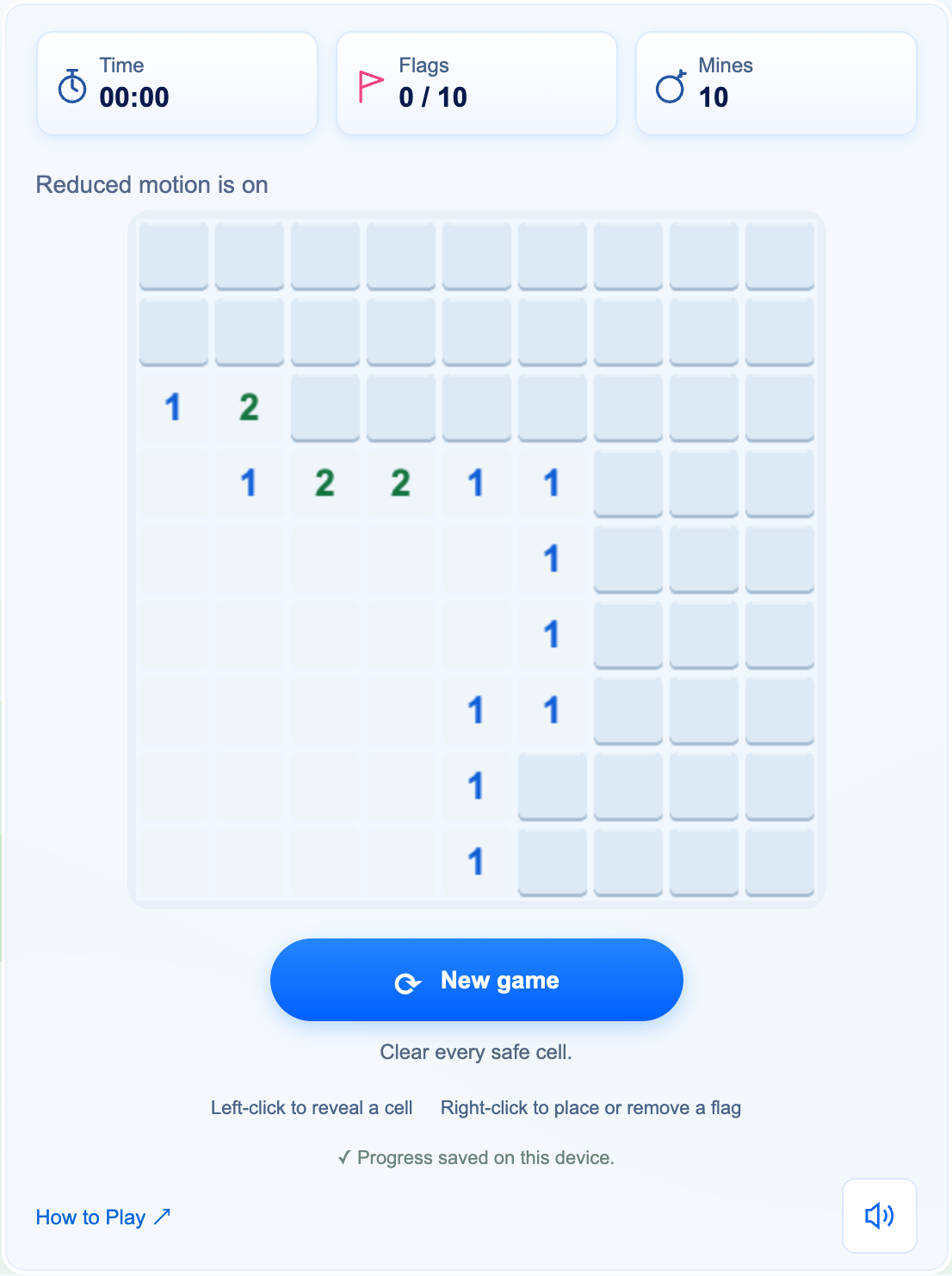
Start on Easy: 9 × 9 cells and 10 mines. Medium has 16 × 16 and 40; Expert has 30 × 16 and 99. Expert can wait. It is very good at waiting for one careless click.
Click or tap to reveal. A number counts mines in the touching cells, diagonals included. Empty areas open automatically. Right-click a covered cell, or hold it for half a second on your phone, to place a flag. Do it again to remove the flag. There is no question-mark stage here.
Once the number of neighboring flags matches an open number, click that number to open its unflagged neighbors. This is called chording. The game counts your flags; it does not admire your reasoning. A wrong flag can still blow up the board. Prefer keys? Arrows move, Enter or Space reveals, F flags and C chords.
Reveal every safe cell to win. You do not have to plant a flag on every mine. And relax about the opening: your first revealed cell and its neighbors are guaranteed safe. That protection is for the opening, not a lifetime warranty.
1–2–1: your first tiny party trick
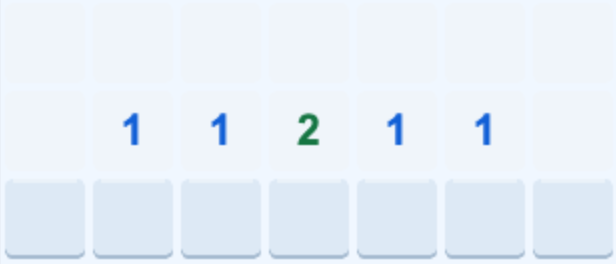
Look at the 1–2–1 in the middle row below. There is a single covered row beneath it, and the other neighboring cells are open. The mines go directly below the two 1s. Below the 2? Safe. Suddenly you look like someone with a plan.
Why? Suppose the cell directly below the 2 were a mine. Each outer 1 would then have its one mine already, ruling out every other cell touching the 2. But the 2 still needs a second mine. Contradiction. So the middle cell is safe, and the two cells on either side must supply the two mines.
Check the shape before showing off. Extra covered neighbors above or beside a clue can change the conclusion. A familiar string of numbers is not permission to click blindly.
Cropped teaching positions captured from the OnlinePuzzle game. Read the outlined clues in the middle row; the covered row immediately below it is the frontier. All other neighbors of those clues are revealed. These are still images, so save your clicks for the game page.
1–2–2–1: same idea, mines in the middle
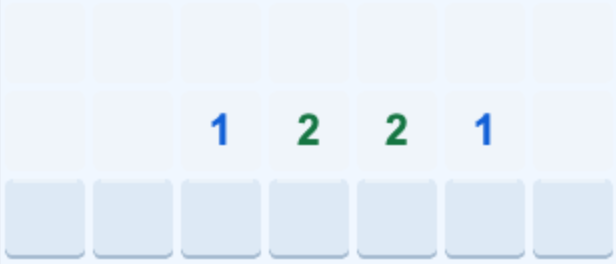
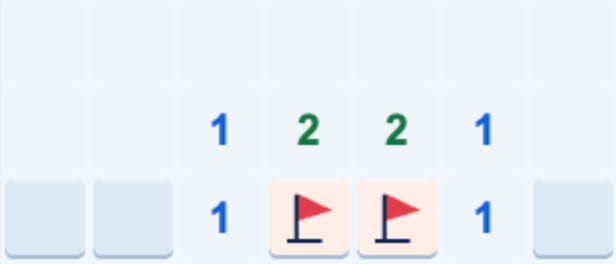
For the straight frontier shown here, the result flips: the two middle cells are mines and the two outer cells are safe. Say it once, then check the picture. Your memory will try to swap this with 1–2–1 at the least convenient moment.
Compare the left 1 with the neighboring 2. The 2 needs one more mine, forcing the cell below the other 2 to be a mine. Mirror the argument from the right and you get the second middle mine. Those two mines satisfy both 2s and both 1s, leaving the outer cells safe.
Patterns can hide behind bigger numbers. Subtract correctly identified neighboring mines first: a 2 touching one confirmed mine has one mine left to find. Then compare the remaining covered neighbors. Do not subtract a flag merely because you felt optimistic when placing it.
No neat pattern? Compare what the clues share
A straight edge full of 1s and 2s can look like the board has run out of ideas. Usually it is asking you to compare overlapping groups of cells.
For example: after accounting for confirmed mines, one clue says there is exactly one mine among cells A and B. Another says there is exactly one among A, B and C. The mine is already accounted for in A and B, so C is safe. If the second clue instead needs two mines, C must be a mine.
This is the useful bit behind many “magic” patterns: one group sits entirely inside another. Check every neighbor, including diagonals. And do not invent a 1–2–2–2–1 rule just because the numbers look nicely arranged.
The endgame: remember the whole board
Before declaring the last few cells impossible, check the total. Easy has 10 mines, Medium 40, Expert 99. The Mines counter shows the total minus your flags. It is bookkeeping, not proof that those flags are right.
Suppose you have four mines left after accounting for confirmed mines. Four separate, non-overlapping groups each require exactly one mine. That uses all four, so every other unflagged covered cell is safe. You may not know which cell is mined inside each group yet, but you can open cells outside them and get new clues.
Do not count the same possible mine twice in overlapping groups. Also, a huge empty opening does leave the remaining mines packed into fewer cells, but that alone does not tell you how hard the board will be. A 2 is not automatically a better clue than a 1; what matters is what the neighboring clues let you prove.
Where to start, and when guessing really is guessing
Center or corner? Here, both get first-click protection. A central opening can give you edges to explore in several directions; a corner gives you fewer neighboring cells to track. Try both. Neither opening is a secret pass to a guaranteed win.
When one edge stalls, inspect another before taking a chance. Check reduced clues, overlapping groups and the remaining mine total. If multiple mine arrangements still fit everything you can see, there may genuinely be no certain move. This game does not promise guess-free boards.
At that point you can ask a friend to choose. It will not improve the mathematics, but it does diversify the blame. More seriously: a lost guess does not mean the deductions before it were wrong.
Speed comes after the “oh, now I see it”
First aim to finish an Easy board while knowing why you made each move. Then practice spotting 1–2–1 and 1–2–2–1, and use chording only after checking your flags. Familiar shapes make you faster; frantic clicking mainly makes the game shorter.
Head back to the game and try one round. If you get stuck, come back to the matching tip. One more game for practice is perfectly reasonable. Whether it stays at one is between you and the clock.