To solve Sand Block Puzzle, clear a route for an existing block, slide it onto a matching outlet square in the top row, and use the space it leaves to reach the next color. Plan both the route and the outlet order. The whole block must fit the route.
This guide covers OnlinePuzzle’s 10-level sliding puzzle. You move existing receivers, rather than dropping new shapes or completing lines. With no countdown, take time to plan each slide.
The rules that determine a useful move
- Move a block horizontally or vertically through empty cells. It cannot rotate, overlap another block, cross a wall, or jump over an obstacle. Arrow-marked bars follow their marked axis.
- You can stop at any reachable cell. One straight slide counts as one move, regardless of distance; turning a corner requires another slide.
- A matching block must cover the outlined outlet square in the top receiving row. Releasing it there starts the fill automatically. The filled block disappears.
- The exposed bottom color of an outlet is active. Clearing its matching receiver reveals the next layer. A wrong-colored block does not consume the sand.
Read the supply before choosing a block
Start with the active color at each outlet, then inspect what comes after it. Think of the next receiver as a second destination to protect. Clearing a red block may make yellow available, but parking another piece across yellow’s route can cancel the benefit.
Do not confuse a clear destination with a clear journey. Trace every cell of the moving shape through the corridor. For an L or T block, its projecting arm matters just as much as its leading cell. If a passage is too narrow, find a blocker you can move aside.
A worked opening: Level 1, First Jam
The opening board has a red receiver A, a blue receiver B and a yellow L-shaped receiver C. The left outlet supplies red before yellow; the right outlet supplies blue. The following route uses four straight slides from the starting arrangement:
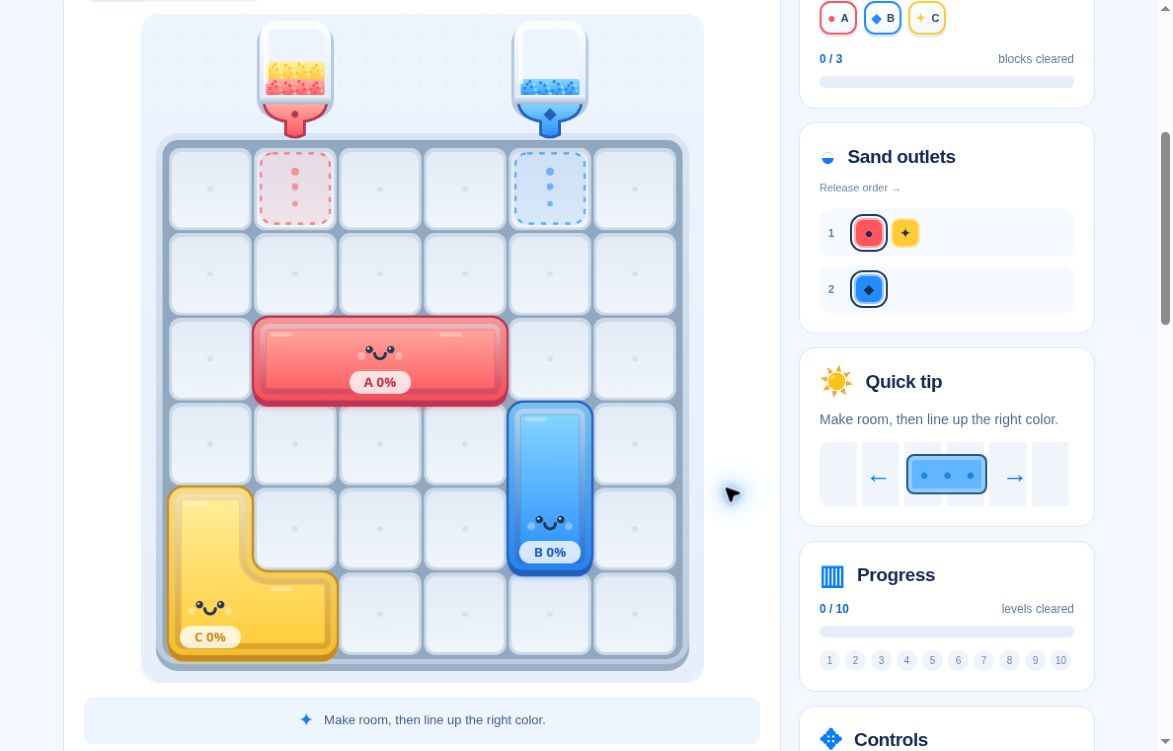
- Slide blue B upward three cells. It reaches the right matching outlet, fills and clears.
- Slide red A upward two cells. It clears at the left outlet, exposing yellow.
- Slide yellow C upward four cells. It reaches the top, but its top cell is still left of the outlet. This setup slide does not clear it.
- Slide C right one cell. Now its top cell covers the yellow receiving square, so the final block can fill and clear.
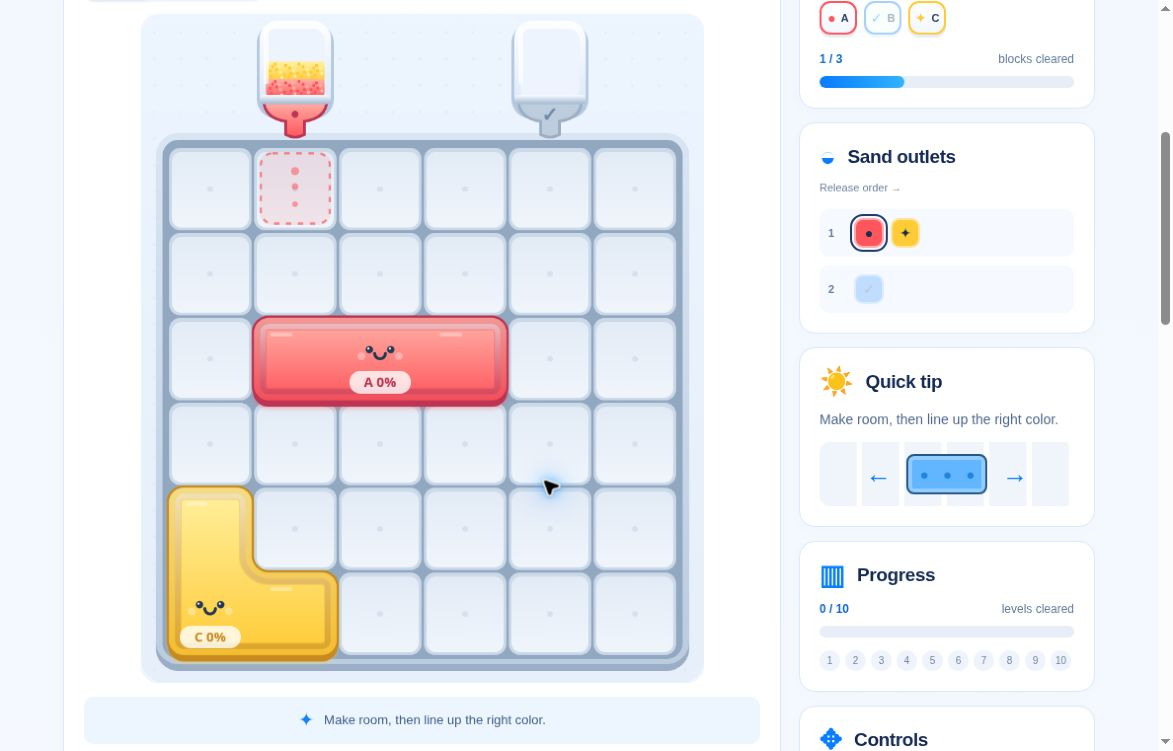
The third slide shows why reaching the top is not enough: cover the correct outlet square. This is one working route, not a proven minimum.
Make room without losing the next route
Give each temporary move a job: open a vertical lane, release a wide shape, or preserve access to an outlet. Before parking, check which piece needs those cells next. Empty space near an outlet is often a working area, not a convenient storage corner.
After a clear, stop and read the board again. Two things have changed: a shape has vanished and an outlet may have changed color. Use longer uninterrupted slides rather than splitting one straight journey into several counted moves.
Common mistakes and how to recover
- Waiting below the right color: move into the top receiving square; sand does not fill a block merely because it is somewhere underneath.
- Trying to rotate a difficult shape: move surrounding blocks instead, keeping the shape’s orientation.
- Treating a wrong-color outlet as a sand loss: the sand remains; the problem is the route you are blocking.
- Restarting after every mistake: Undo restores the move, including a completed fill and the previous outlet layers. Review the misplaced block first.
Hints reveal help in stages: a block, a direction, then a route. Use only the help you need. If a limited search cannot find a continuation, that is not proof that your position is impossible.
Sand Block Puzzle FAQ
Is Sand Block Puzzle a sand Tetris game?
No. This version moves existing receivers along a grid. It does not drop new pieces or clear completed rows.
Why does a matching block not fill?
It must cover the matching outlet square in the top row, not simply sit below that outlet. Check the active color and the entire route.
Can I rotate the blocks?
No. Keep each shape’s orientation. Bars with directional arrows can slide only along their marked axis.
Can Undo bring back a filled block?
Yes. Undo restores the previous move, including removed receivers and the outlet layers they consumed.
Is there a time limit?
No. The optional move challenge compares your result with your own best; it does not add a countdown.
Try the route in Sand Block Puzzle, then replay it while explaining why each slide is needed.