Two-suit Spider: uncover cards, keep room to rearrange
Spades and hearts are easy to tell apart. Keeping them apart while uncovering the cards underneath is the tricky bit. A useful move should reveal information, improve a movable run, or make room for the next rearrangement.
Play Spider Solitaire 2 Suits →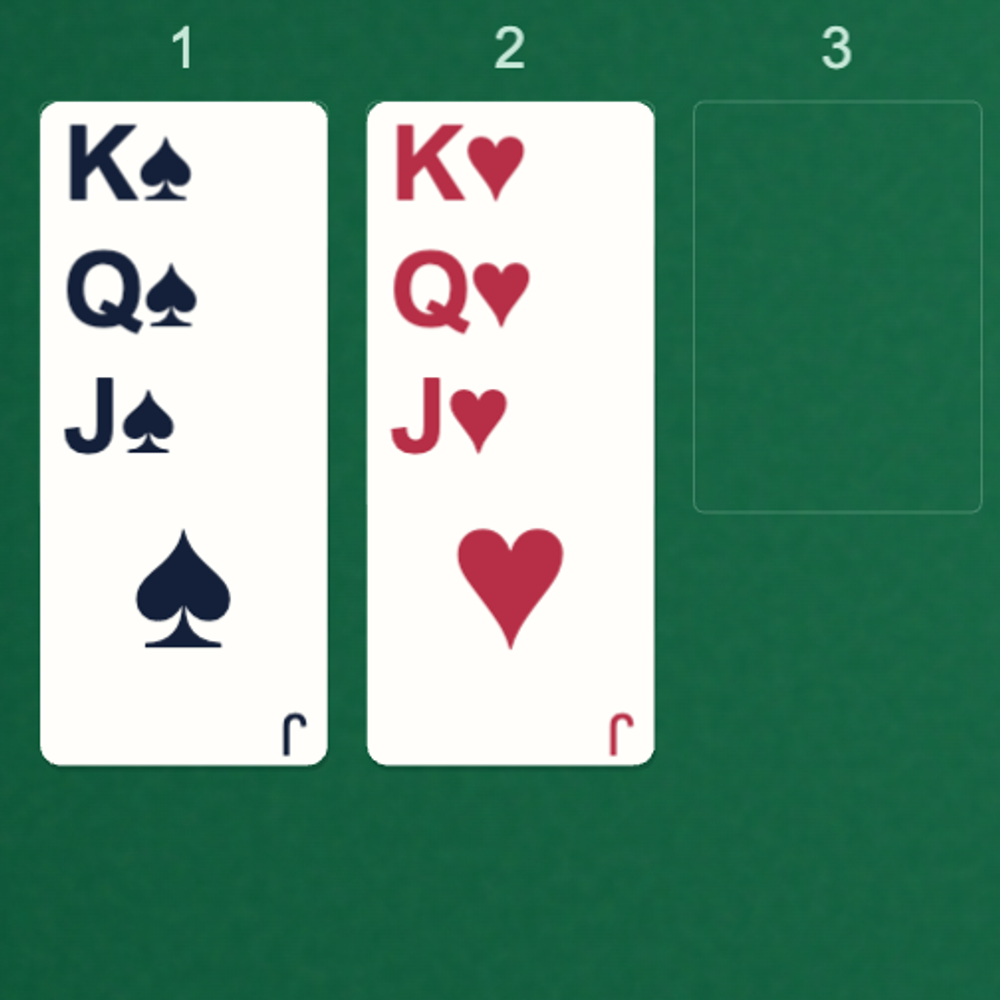
Start with the rules that change your decisions
This mode uses 104 cards: spades and hearts, with four copies of each rank in each suit. Put a lower card onto a card exactly one rank higher: 9♠ on 10♠ or 9♥ on 10♠ are both legal. An Ace goes on a 2; a King cannot go on another rank. This is not Klondike: alternating colors is not required.
Only a face-up, descending, same-suit run can move as a group. In 10♠–9♥–8♥, the 9♥–8♥ pair can move together, but all three cannot. Any single card or legal run can fill an empty column. Complete eight same-suit K-to-A runs to win; completed runs clear automatically.
Prefer matching suits, but compare what you uncover
Joining 9♠ to 10♠ creates a movable pair. That is usually useful, but it is not always better than uncovering a hidden card elsewhere. If 9♥ on 10♠ exposes an important card or frees a column, the temporary suit break may be worth it. Ask how you will remove that 9♥ later.
When two identical cards can make the same move, compare the columns beneath them. Undo lets you inspect alternatives as practice; it gives you information you did not have before, not proof that the chosen line wins. There is no universal rule to move larger cards first. Choose the order that preserves legal destinations and exposes useful cards.
An empty column is a workspace
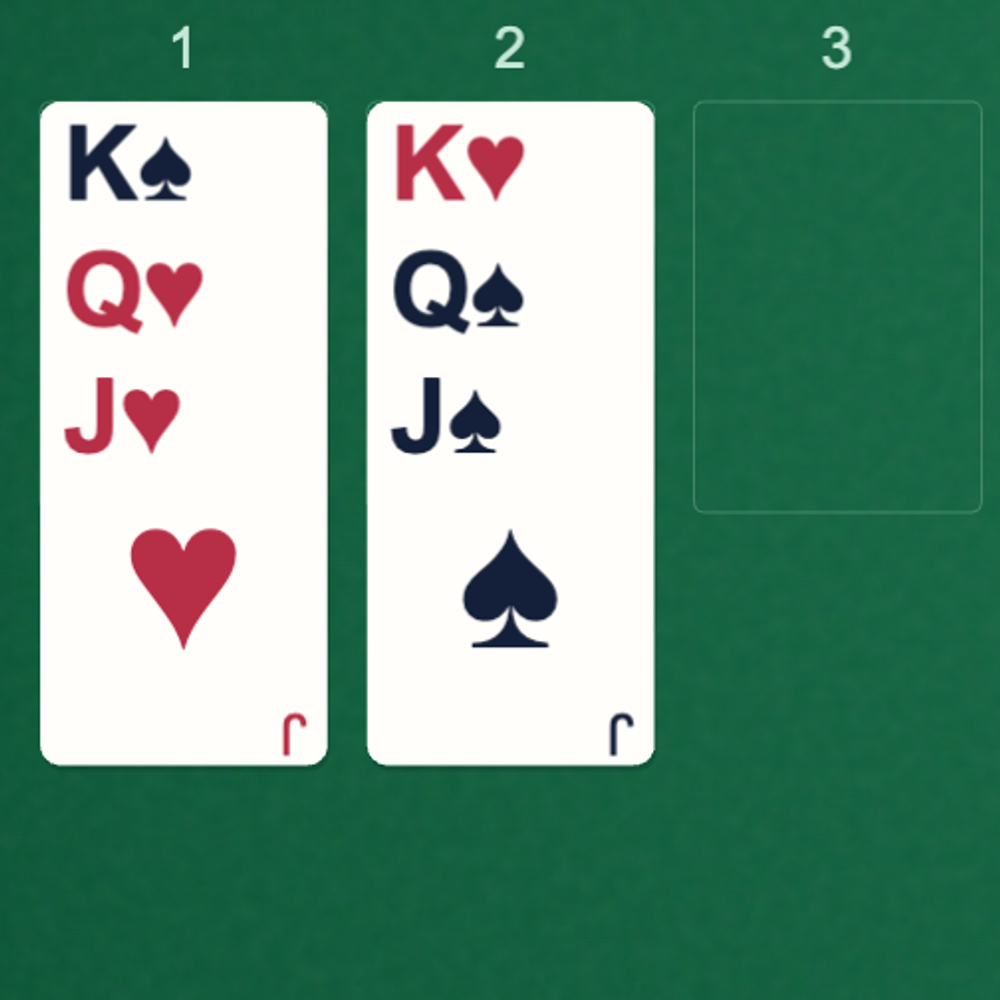
Try to create an empty column when the cost is reasonable, then use it to separate suit blocks. The example below shows why a vacancy can be more useful than a long mixed column. The Q–J pairs are movable because each pair shares a suit.
Do not automatically fill your only vacancy with a King. A King can move only to an empty column, so parking it there may tie up that workspace until you complete its run or make another vacancy. Put it there when that move has a purpose—such as revealing a hidden card or organizing a nearly complete run.
Count suit breaks, not an arbitrary number of cards
A long same-suit run is one movable unit. A shorter mixed run may need several temporary destinations to take apart. This is why rules such as “never mix more than four cards” or “stack at most three runs” are unreliable. What matters is whether each exposed same-suit block has somewhere to go.
Low cards need care because an Ace cannot support a lower rank. High cards also cause problems if Kings occupy all your spare columns. Before adding another suit break, name the card or empty column you could use to undo that arrangement. If you cannot see one, the move may cost more flexibility than it gains.
Reveal hidden cards before tidying for its own sake
Prefer moves that reveal a hidden card, open a column or join useful matching runs. Moving a neat run back and forth without changing your options is not progress. A reveal is valuable, but weigh it against losing your only workspace or burying a run you cannot separate.
Hint suggests a legal move; it does not prove that the position is winnable or identify a guaranteed best continuation. Consider what its move exposes and blocks. If you explore with Undo, compare the resulting options rather than assuming the first attractive reveal must be right.
Deal when useful preparation is finished
A stock deal adds one face-up card to every column and can break up exposed runs. Before dealing, look for useful reveals and reorganizations. All ten columns must contain cards, so you must fill any vacancies first. Any legal card or run can fill them; Kings are not required.
There is no fixed rule to keep an empty column until the second deal, or to deal whenever a hint seems unhelpful. Use the current board. Undo can reverse a deal while it remains in the saved move history. On the same deal, undoing and dealing again uses the same stock order—it is not a fresh shuffle.
Four completed runs are progress, not a guarantee
Removing runs creates room, but completing four does not prove that the rest is solvable. Nor does a fixed deck imply a single predetermined winning route. Some choices converge, some close options, and this game does not promise that every deal can be won.
If you stall, revisit the decision that used your last empty column, added a difficult suit break or triggered a premature deal. Try a different plan with the Undo button. A useful routine is: check reveals, join matching runs, preserve a workspace, then consider dealing. Practice explaining why a move helps—not just whether it is legal.