Four-suit Spider: make room before you make a move
Four suits turn a tidy-looking column into a surprisingly awkward puzzle. The aim is not to stack every card that fits. It is to uncover information while keeping enough useful destinations to untangle the board later.
Play Spider Solitaire 4 Suits →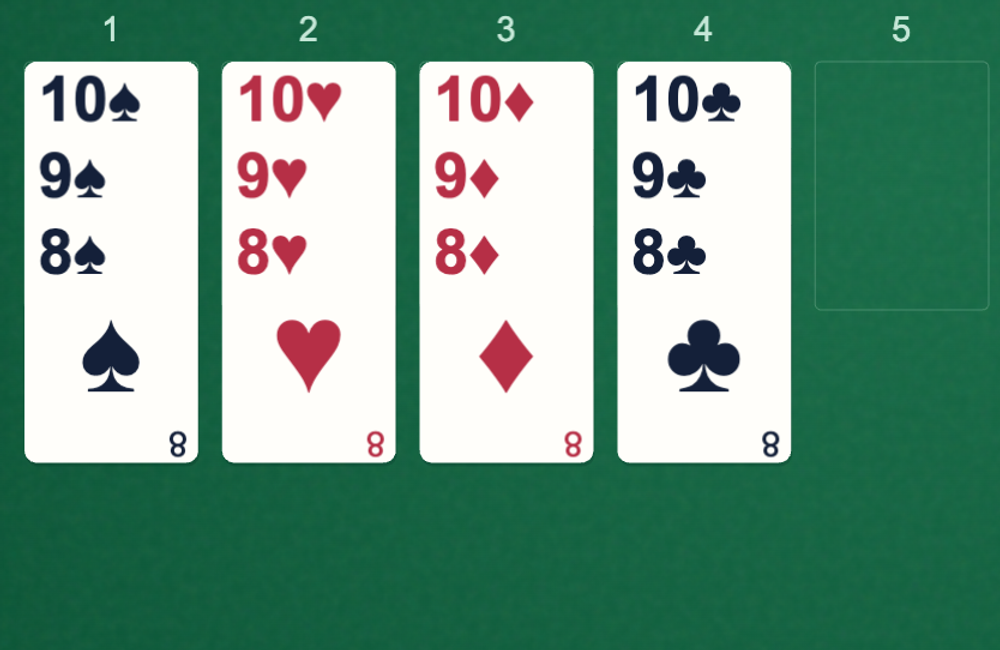
Know which groups can actually move
Four-suit Spider uses two decks: 104 cards, with two copies of each rank in each suit. Place a card on a card exactly one rank higher, regardless of suit. But a group moves only when its exposed cards descend consecutively in the same suit. Red and black are not the rule: spades and clubs are different suits, as are hearts and diamonds.
Any card or movable group may fill an empty column. A same-suit King-to-Ace sequence clears automatically; complete eight to win. Mixed suits can be useful temporarily, but every suit boundary is another part you may need to separate.
Reveal early, without sacrificing every useful column
Early reveals usually teach you more than cosmetic rearrangement. Compare moves by what they expose, whether they free a column, and whether the moved group will still have an exit. “Dig early, sort later” is a useful reminder, not a rigid division: a small reorganization now may enable your next reveal.
You can restart to practice a more approachable opening, but an attractive first row does not prove a deal is winnable. Pick a training goal—such as creating a vacancy or keeping two same-suit groups movable—instead of judging progress only by wins. A difficult column may become useful after a reveal or deal, so do not declare it permanently dead.
Use an empty column to rotate groups
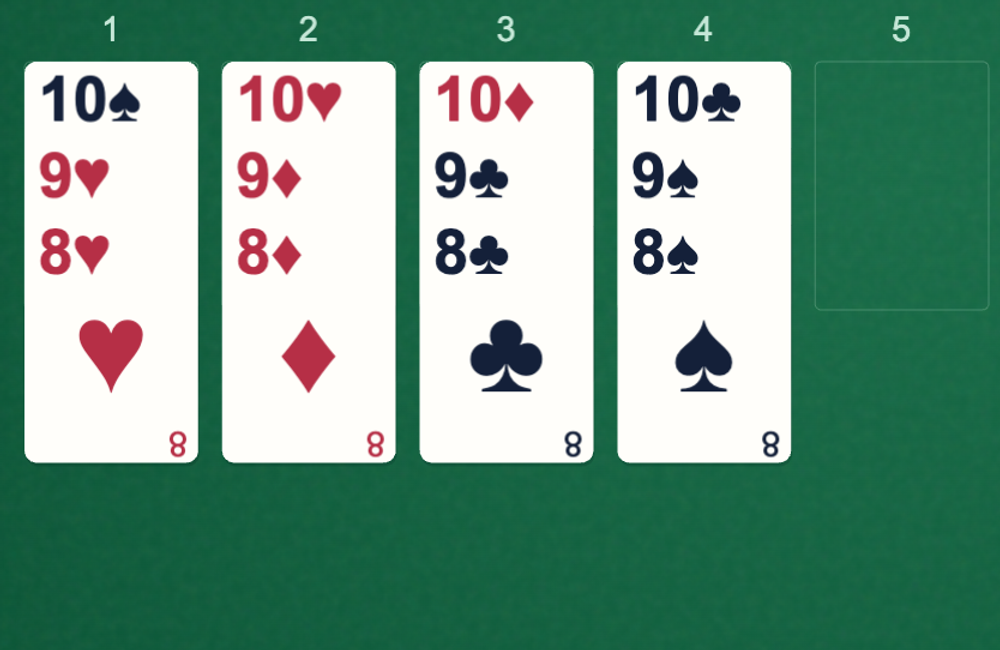
An empty column is temporary working space. Before using it, plan which group goes there, what that frees, and how you will empty it again. In this example each 9–8 pair is movable, but it sits under the wrong 10. Five legal moves align all four suits without leaving the spare column occupied.
This works because each pair is consecutive and same-suit, and the newly exposed 10s are legal destinations. One vacancy is not a universal cure for every mixed stack. If a supposed group contains another suit break, you may need extra destinations before the exchange is possible.
Treat missing ranks as blocked destinations
Every rank has eight cards across the two decks. If many exposed 7s have no available 8, the problem is access, not fewer 8s in the deck. An 8 may be face down, buried, or still in the stock. Look for a reachable 8, a move that exposes one, or a vacancy that lets you relocate a 7-group.
You may temporarily cover a 7 if that move has a concrete benefit, but hiding it does not solve the missing destination by itself. Decide how you will remove the covering group later. Alternating red and black can make boundaries easier to see; it does not make a mixed group movable.
Give Kings and Aces a job
A King can move only to an empty column. Do not park it in your last vacancy by habit: that may use up the space you needed for sorting. Moving it is valuable when it reveals a card or starts a sequence you can realistically complete. An Ace cannot carry a lower rank, but moving it onto a 2 may reveal an important card or finish a run.
When a stock deal puts a King over a useful group, Undo can let you test a different arrangement before that deal. Check all ten incoming cards, not just where that King lands. Sending it onto an already awkward column may protect another column, but it also makes the buried cards harder to recover.
Prepare the next deal instead of moving automatically
Adjacent ranks do not have to be stacked just because the move is legal. Preserve useful exposed destinations and make meaningful reveals or exchanges first. A stock deal then adds one face-up card to every column, potentially creating new options and new suit breaks. You cannot deal while any column is empty, so fill vacancies deliberately before using the stock.
Do not deal merely in the hope that one perfect card will appear. Compare the moves already available and the cost of delaying. Undoing and repeating a deal preserves the same stock order; it does not reshuffle the cards.
Use Undo to compare plans, not to promise a win
Use the Undo button to return through the available saved move history and test an alternative. Remembering a revealed card can be useful practice, but it is information learned by exploration. Revisit the decision that spent your last vacancy or buried a needed rank, rather than repeatedly changing an unrelated final move.
Neither a tidy opening nor several completed runs guarantees a win. Before each move, ask: what do I reveal, what destination do I lose, and how can I free this group later? If all three answers are unclear, pause and compare another line. That habit is more reliable than a fixed rule to abandon one column and protect another forever.