How to get better at Word Search without scanning the same row twice
You know the word is in there. You have read the same row three times, and somehow it still looks like a jumble. The fix is usually to give your eyes a smaller job: one word, one starting letter, one direction at a time.
Play Word Search →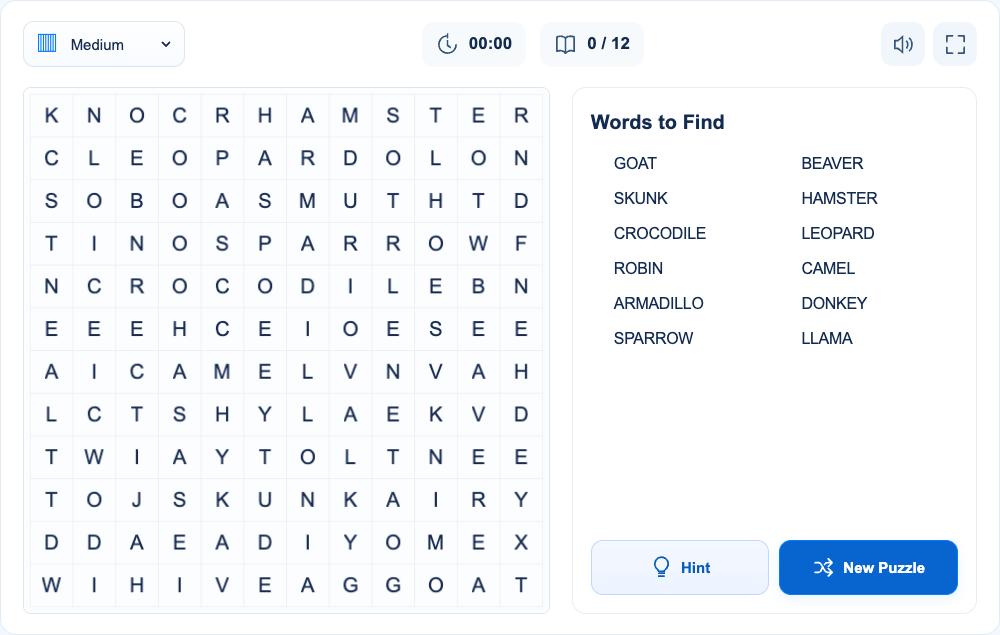
Check the difficulty before you start looking
Read the word list once before searching. Pick a word you can hold comfortably in your head, then check the difficulty. On Easy, there is no reason to spend time hunting diagonals: the generated words run left to right or top to bottom. Medium adds the two downward diagonals. Hard adds reverse and upward directions as well.
The grids also grow: Easy has 8 words in a 10×10 grid, Medium has 12 in a 12×12 grid, and Hard has 16 in a 15×15 grid. Start with a familiar theme if remembering unfamiliar words keeps pulling your attention away from the board. You still need to find the exact words in the list, not any animal name you happen to notice.
Give each row one careful pass
Choose one target and scan the rows from top to bottom for its first letter. At each match, check the second letter before reading the rest. If the second letter is wrong, move on. This is easier to keep track of than trying to recognize all twelve words at once.
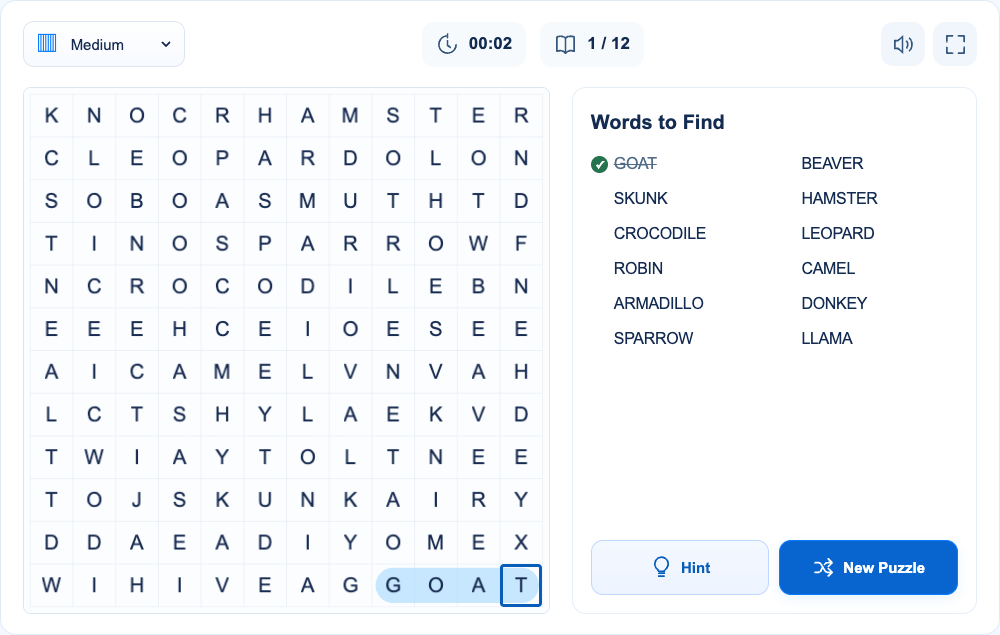
In our example, GOAT is on the bottom row. Find G at row 12, column 9, then check O, A and T to its right. Select the two ends, or drag along those four letters. The counter changes to 1 / 12 and GOAT is marked in the list.
If a word starts with a very common letter, use a more distinctive pair inside it instead. Once you spot the pair, work backward to the start and forward to the end along the same line. A promising two-letter match is a lead, not yet an answer.
Read diagonals one step at a time
Diagonal words are easy to miss when your eyes keep returning to horizontal rows. Once you have a possible starting letter, move one row and one column together. Keep that direction until the word ends; you cannot turn a corner or skip a cell.
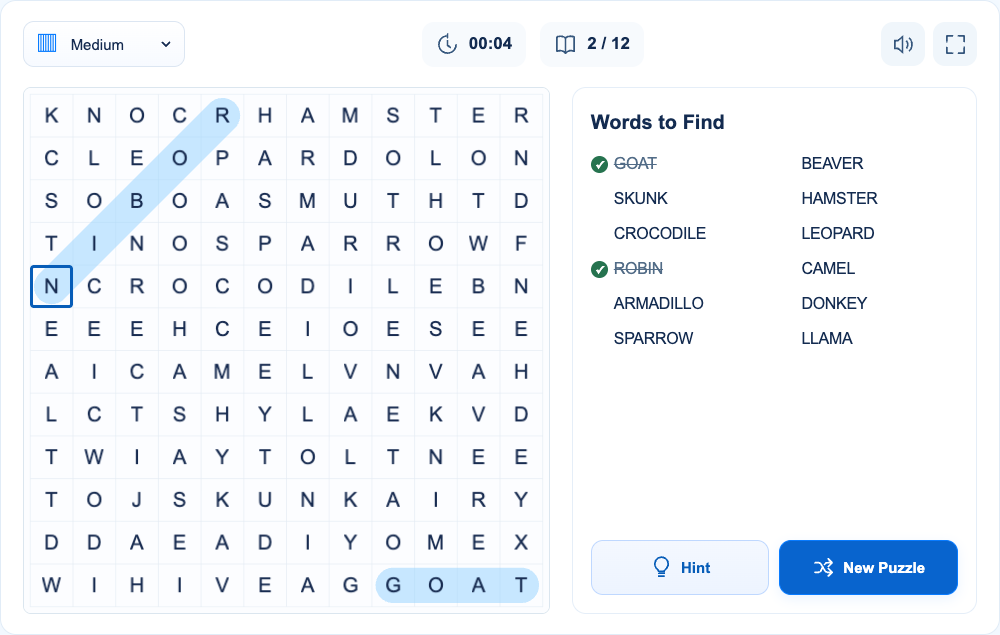
ROBIN starts at row 1, column 5 in this puzzle. R → O → B → I → N travels down and left to row 5, column 1. Counting the five letters makes the end point clear. Medium permits this direction; it does not mean every diagonal has to slope down to the right.
On Hard, try reading from the final letter toward the first if a word looks almost familiar. You can select a correctly placed word from either end. That selection convenience is separate from the directions used to generate each difficulty.
Do not discard letters you have already used
A highlighted letter can belong to another word. Treat completed words as landmarks, not as areas you should stop searching. If an unfound word contains the same letter, check whether a straight path through that cell gives you its neighbors in the right order.
When only two or three targets remain, work from the list again. Check their lengths, look for repeated letters or an unusual pair, and inspect one direction at a time. Randomly sweeping the whole grid often brings you back to the words you already found.
Match what is written. Spanish and Portuguese puzzles preserve accents and letters such as Ñ and Ç. In themes with multiword names, the list may show a spaced title and an “In the grid” form: follow that compact form rather than looking for blank spaces between words.
Use a hint as a starting point
If you have checked the same area repeatedly, take a hint and change the question from “Where is it?” to “Which word could start here?” Hint briefly marks the first letter of an unfound word. It does not draw the full answer, select it for you or remove it from the list.
Look at the remaining words beginning with that letter, then test their second letters in the directions available at your difficulty. Follow a candidate only while every letter matches. Hints are unlimited, but their use is recorded, so you can see how much help a round took.
There is no need to race the timer while learning. Compare your own times within the same language, theme and difficulty, and note whether you used hints. A larger grid or an unfamiliar set of words makes a different task.
Make selection comfortable, then practice one thing
On a phone, tapping the first and last letter can be more precise than dragging a long diagonal. If the large grid scrolls, move it into view and tap the two ends. Fullscreen is also available. With a keyboard, focus the grid, move with the arrow keys, press Enter or Space to mark a start, move to the end and press again. Escape cancels the selection.
For your next puzzle, choose one habit to practice: finish each row before moving down, check the second letter before tracing a word, or deliberately search diagonals. You do not need a new trick for every word. A repeatable search is what stops you getting lost.
Progress is stored in this browser when storage is available, separately for each language, theme and difficulty. Return to that combination to continue. A new puzzle replaces that round; saved progress does not follow you to another device.